
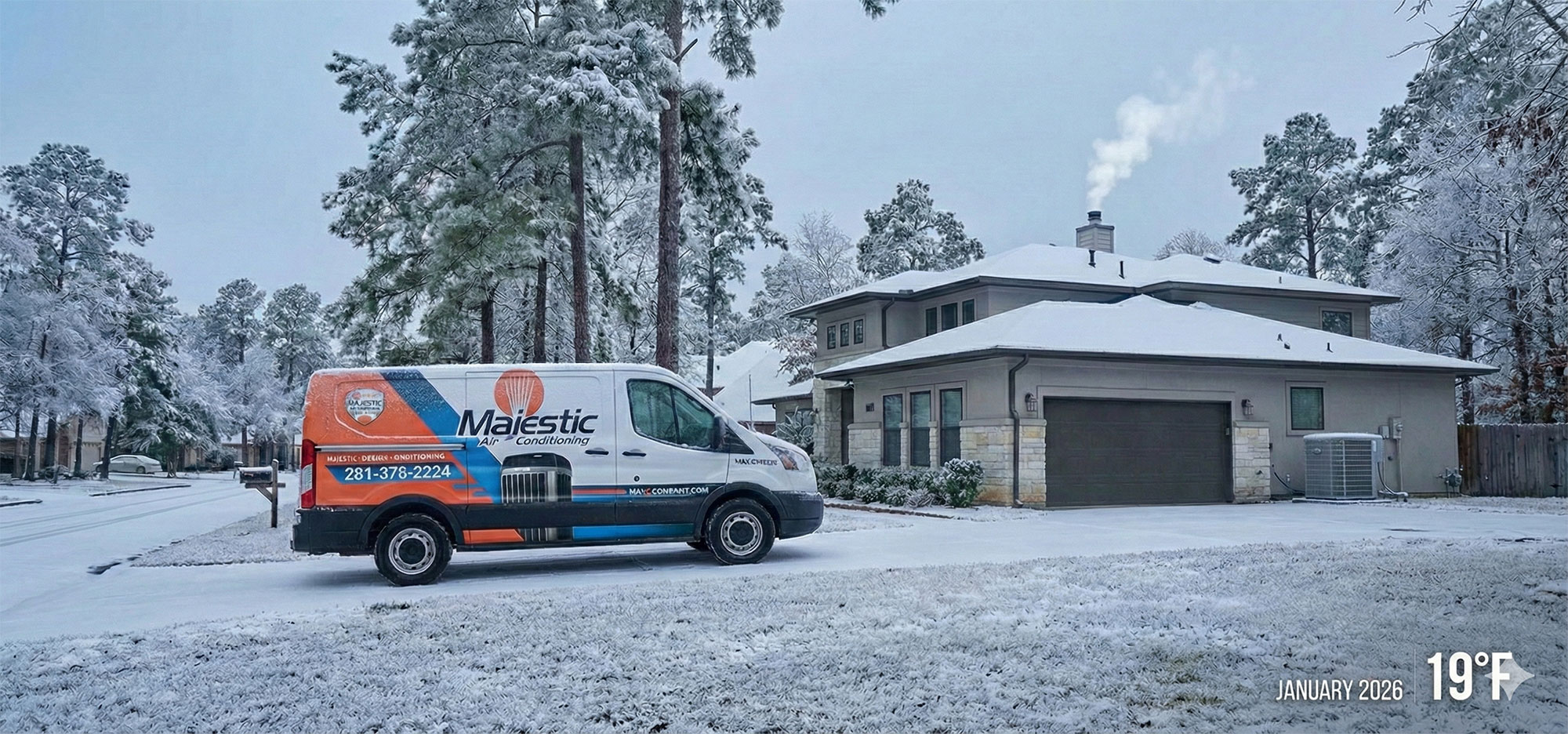
The current cold snap hitting Spring and The Woodlands, Texas, in late January 2026 is more than just a passing front—it is a significant weather event that has prompted disaster declarations and placed immense strain on residential infrastructure. For homeowners in Montgomery County and Northern Harris County, the primary concern isn’t just staying warm; it’s ensuring that the systems designed to keep us safe don’t fail when we need them most.
At Majestic AC, we understand that a Texas winter is a unique beast. We often swing from air conditioning to heating within the same 48-hour period, a cycle that can hide underlying mechanical weaknesses until a sustained freeze arrives. When temperatures drop into the teens and stay there for extended periods, your HVAC system is no longer just a comfort appliance—it is a critical life-safety tool. This comprehensive guide addresses the specific challenges of the 2026 freeze, the mechanics of how your system handles extreme cold, and the steps you must take to protect your home and family.
The Reality of the 2026 Texas Cold Snap
The current meteorological data indicates that the Spring and The Woodlands areas are facing a “hard freeze,” defined by temperatures falling below 24°F for several hours. Unlike a light frost, a hard freeze penetrates deeper into structures and mechanical components. The arrival of the Arctic front has brought not just plummeting temperatures but also the threat of freezing rain and ice accumulation.
For residents of neighborhoods like Grogan’s Mill, Panther Creek, or the master-planned communities in Spring, the combination of moisture and extreme cold creates a “worst-case scenario” for HVAC systems. Ice can weigh down power lines, leading to voltage fluctuations that can fry sensitive control boards in your heater. Furthermore, the duration of this freeze—expected to last upwards of 40 to 72 hours—means that systems will be running at 100% capacity for days on end. This is when deferred maintenance typically results in a total system breakdown.
How Your Heating System Works Under Pressure
To understand why your system might struggle during this freeze, it is essential to distinguish between the two primary types of heating found in our region: traditional gas furnaces and electric heat pumps.
The Gas Furnace: Reliable but Vulnerable
Most homes in the Houston metro area utilize natural gas furnaces. These systems work by igniting gas to heat a component called a heat exchanger. Air is then blown over the hot exchanger and distributed through your ducts. During a cold snap, the primary “stressors” on a furnace are the blower motor and the exhaust system.
One often-overlooked danger during a freeze is a blocked flue or vent. If freezing rain or sleet accumulates on the roof, it can obstruct the exhaust pipe of your furnace. This can cause a backup of carbon monoxide (CO) into the home. Additionally, gas furnaces rely on a steady flow of oxygen. If your home is sealed too tightly with plastic or heavy weatherstripping without regard for ventilation, or if the intake is blocked by ice, the furnace may “short cycle,” turning off and on frequently to prevent damage, which ultimately leaves your home cold.
The Heat Pump: The Battle Against Ambient Air
Heat pumps are increasingly popular in The Woodlands because of their high efficiency during our typically mild winters. A heat pump works by moving heat from one place to another. Even in 30°F weather, there is still thermal energy in the outside air that the system can extract and move indoors.
However, as temperatures drop into the low 20s or teens, the efficiency of a standard heat pump begins to decline. This is where the “Defrost Cycle” becomes critical. In the current 2026 freeze, you may notice your outdoor unit becoming covered in white frost or even a thin layer of ice. This is normal to an extent. The system is designed to periodically reverse its operation to send heat back to the outdoor coils to melt that ice.The problem arises when the ice is too thick or the defrost sensor fails. If you see a thick “igloo” of ice encasing your outdoor unit, the heat pump can no longer breathe. It will struggle to extract heat, and eventually, the system may shut down to prevent the compressor from burning out. Most modern heat pumps in our area are equipped with “Emergency Heat” or “Auxiliary Heat” (electric heat strips). While these will keep you warm, they are significantly more expensive to run and should only be viewed as a temporary backup during the peak of the freeze.
Critical HVAC Concerns During a Hard Freeze
The current weather conditions in Spring and The Woodlands bring several specific technical concerns that homeowners should monitor.
1. Frozen Condensate Lines
High-efficiency furnaces and many AC units produce condensation even in the winter. This water is usually carried away through a small PVC pipe. In extreme cold, if this line is exposed to the elements or runs through a drafty attic, the water inside can freeze. If the line is blocked by ice, the water backs up into the furnace. Most modern systems have a “float switch” that will automatically shut the system down if it detects water backing up. If your heater suddenly stops working and you see water in the secondary drain pan, a frozen condensate line is a likely culprit.
2. Thermostat Disconnects
During a cold snap, many homeowners are tempted to “crank up” the heat to 75°F or higher. This creates a massive delta between the indoor and outdoor temperatures, forcing the system to run without a break. This constant operation can lead to “thermostat lag” or even a complete communication failure between a smart thermostat and the furnace control board. We recommend setting your thermostat to a consistent, reasonable temperature—around 68°F—and leaving it there. The goal during a freeze is maintenance of temperature, not rapid heating.
3. Airflow Obstructions
In an effort to keep the house warm, many people close off vents in unused rooms. In reality, this is one of the worst things you can do for your HVAC system during a freeze. HVAC systems are “balanced” for a specific amount of airflow. Closing vents increases the static pressure inside your ductwork, which can cause the heat exchanger in a furnace to overheat or cause a heat pump to struggle. Keep all interior doors open and all vents clear of furniture and rugs to ensure the system can “breathe” properly.
4. Carbon Monoxide Safety
This is the most critical concern for any home with a gas furnace. Because the system is working overtime, any small crack in the heat exchanger or a slight misalignment in the burner can lead to the production of carbon monoxide. CO is colorless and odorless. During this freeze, ensure your CO detectors are functioning and have fresh batteries. If you experience headaches, dizziness, or nausea while the heater is running, evacuate the home immediately and call emergency services.
Proactive Steps for Spring and The Woodlands Homeowners
While the freeze is currently upon us, there are several “active” steps you can take to mitigate damage and ensure your system stays online.
- Clear the Perimeter: Put on your heavy coat and walk around your outdoor unit. Ensure that there are no leaves, debris, or snow drifts blocking the sides of the unit. A heat pump needs at least 18 to 24 inches of clear space on all sides to operate efficiently.
- Check the Air Filter: A dirty air filter is the number one cause of system failure during a cold snap. If your filter is clogged with dust from the autumn months, the reduced airflow will cause the system to work twice as hard. Change your filter today with a basic pleated filter—avoid the ultra-high MERV ratings during a freeze as they can actually restrict airflow too much for a struggling system.
- The “Drip” Method for Pipes: While this is a plumbing tip, it affects your HVAC too. If your furnace is located in the attic (common in The Woodlands), it is likely surrounded by uninsulated water pipes. Running a slow drip of both hot and cold water helps keep the ambient temperature in those wall cavities slightly higher, which can prevent a pipe from bursting and flooding your HVAC system located below.
- Monitor the Outdoor Unit’s Sound: If you hear a loud, rhythmic “thumping” or a high-pitched “squealing” from your outdoor unit, it may be struggling with ice on the fan blades. Do not attempt to de-ice it with a hammer or sharp object, as you can easily puncture the delicate aluminum fins or refrigerant coils. Instead, you can carefully pour lukewarm (not boiling) water over the ice to help melt it, or switch your thermostat to “Emergency Heat” to give the outdoor unit a break.
When to Call Majestic AC for Emergency Service
Despite your best efforts, mechanical failures happen. Knowing when to call for professional help can save you from a much larger repair bill down the line. You should contact us immediately if:
- You smell gas or a “burning” odor: While a slight “dusty” smell is normal when the heater first kicks on, a persistent burning smell or the smell of rotten eggs (mercaptan) indicates a serious gas leak or electrical short.
- The system is “short cycling”: If your heater turns on for three minutes and then shuts off, it is likely hitting a safety limit. This is often caused by an overheating heat exchanger or a faulty flame sensor.
- The temperature continues to drop indoors: If your thermostat is set to 68°F but the indoor temperature has fallen to 60°F and the system is still running, it is not keeping up. This could be due to a refrigerant leak or a failed compressor.
- Strange noises: Loud banging, clanking, or grinding noises are indicators of mechanical failure in the blower motor or the inducer fan.
Majestic AC provides 24/7 emergency services to the Spring and The Woodlands area. During weather events like the 2026 freeze, our technicians are out in force to ensure our neighbors stay safe. We prioritize emergency calls where children, the elderly, or those with medical conditions are at risk.
Looking Ahead: Winterizing for the Future
Once this cold snap passes—and it will—it is vital not to simply forget about your HVAC system until the summer heat hits. The 2026 freeze has exposed the vulnerabilities of many systems in North Houston.
The best way to prevent a crisis during the next freeze is through a professional winterization tune-up. A Majestic AC technician can inspect your heat exchanger for cracks, test your defrost control board, and ensure your heating elements are drawing the correct amperage. We also recommend considering a “Dual-Fuel” system upgrade if your current unit is over 10 years old. These systems combine the efficiency of a heat pump with the raw power of a gas furnace, providing the perfect balance for the unpredictable Texas climate.
Additionally, consider your home’s “envelope.” Many homes in The Woodlands, especially those built in the 1980s and 90s, may have degraded attic insulation. If your heater is running constantly but your home still feels drafty, the issue might not be the HVAC system itself, but rather the loss of heat through the ceiling. We can help assess your insulation levels and suggest improvements that will save you money in both the winter and the summer.
Conclusion
The 2026 cold snap is a reminder that while we live in a warm climate, we must always be prepared for the extreme. Your HVAC system is your primary line of defense against the elements. By understanding how it works, monitoring for signs of trouble, and performing basic maintenance like changing filters and clearing debris, you can navigate this freeze with confidence.
Stay warm, stay safe, and remember that Majestic AC is here for the Spring and The Woodlands community. Whether you need an emergency repair in the middle of the night or a comprehensive system evaluation once the ice melts, our team of NATE-certified technicians is ready to help.