
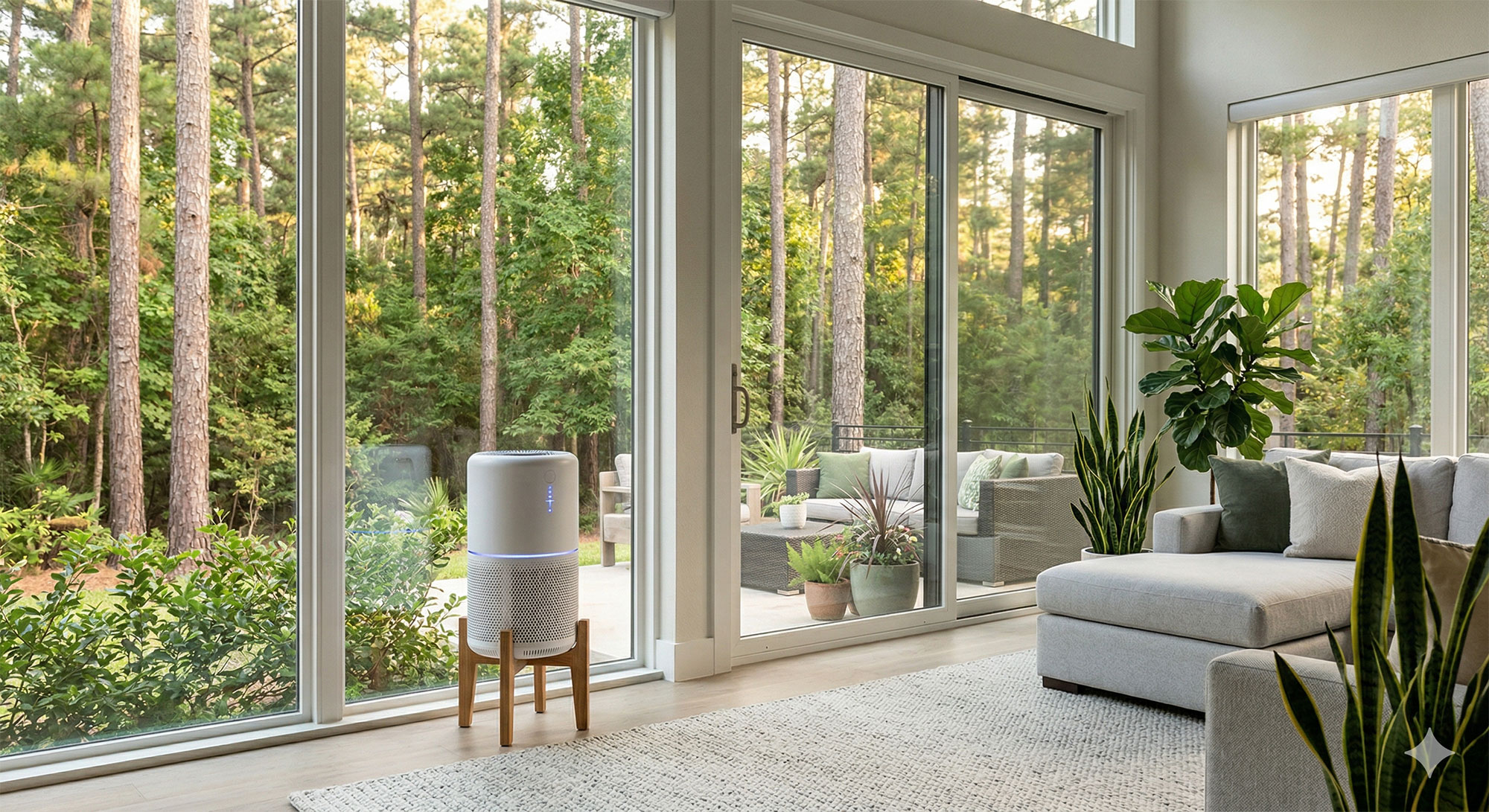
The lush, green landscape of The Woodlands is one of the primary reasons many of us chose to call this community home. Between the towering pines of Carlton Woods and the winding trails of Grogan’s Mill, we live in a literal forest. However, as any resident of Spring or The Woodlands can tell you in April 2026, that beauty comes with a heavy price: some of the most intense pollen counts and indoor air quality challenges in the state of Texas.
At Majestic AC, we’ve noticed a significant shift in the questions our neighbors are asking. Five years ago, the conversation was almost entirely about cooling. Today, in 2026, the focus has expanded. Homeowners aren’t just asking how to keep their homes cool; they are asking how to keep them clean. With the rise of hybrid work-from-home models and an increased awareness of respiratory health, the “air purifier” has moved from a niche appliance to a major home improvement consideration.
But are they actually worth the investment? Is a $600 portable unit or a $3,000 whole-home system really doing anything for the unique air profile of Montgomery County, or is it just another “smart” gadget taking up space? In this deep dive, we’ll look at the real numbers, the latest 2026 technology, and the specific environmental factors that make air purification in The Woodlands different than anywhere else.
The Woodlands Air Quality Profile: 2026 Reality
To understand if a purifier is worth it, we first have to look at what exactly we are trying to remove from the air. In The Woodlands, we deal with a “triple threat” of air quality issues that are uniquely compounded by our local geography and climate.
1. The Pine and Oak “Yellow Fog”
As we sit in early April 2026, we are in the heart of the “Yellow Season.” The loblolly pines and live oaks that define our neighborhoods are currently releasing massive quantities of pollen. In The Woodlands, pollen counts often reach “Very High” levels for weeks at a time. While pollen particles are relatively large (typically 10 to 100 microns), their sheer volume can overwhelm standard HVAC filters, which are designed primarily to protect the equipment, not your lungs.
2. The Humidity and Mold Connection
The Woodlands sits in a humid subtropical zone. Our average humidity rarely drops below 60%, and in the summer months, it frequently hits 90%+. This is the perfect breeding ground for mold spores. Even in a well-maintained home, the constant cycle of damp air can lead to microscopic mold growth in carpets, behind furniture, and inside ductwork. In 2026, we are seeing more “latent mold” issues than ever before, where the spores are present in the air even if you don’t see a visible patch on the wall.
3. Urban Particulates (PM2.5)
Despite our “wooded” name, we are still part of the greater Houston metroplex. With the continued expansion of I-45 and the Grand Parkway, fine particulate matter (PM2.5) from vehicle exhaust and construction has become a permanent fixture of our local air. These particles are smaller than 2.5 microns—small enough to bypass your body’s natural defenses and enter your bloodstream.
The 2026 Tech Breakdown: How Modern Purifiers Work
If you haven’t looked at air purifiers since 2020, you might be surprised by how much the technology has evolved. We have moved past simple mesh filters into the era of “Active Purification.”
HEPA and the 0.1 Micron Standard
For years, the “True HEPA” (High-Efficiency Particulate Air) filter was the gold standard, rated to capture 99.97% of particles down to 0.3 microns. However, by 2026, high-end residential purifiers have shifted to HEPA H13 or H14, often referred to as “medical-grade.” These systems are now capable of capturing particles as small as 0.1 microns, which includes many viruses and the finest smoke particles.
Activated Carbon and VOCs
In The Woodlands, many of our homes are newer and “tightly built” for energy efficiency. While this is great for your electric bill, it can lead to the buildup of Volatile Organic Compounds (VOCs) from cleaning supplies, new furniture, and cooking. High-efficiency purifiers in 2026 now feature “heavy-load” activated carbon canisters. Unlike the thin black sponges found in older units, these are thick beds of treated charcoal that chemically bond with odors and gases, neutralizing them rather than just masking them.
UV-C and PCO Technology
Photocatalytic Oxidation (PCO) and UV-C light systems have become standard in whole-home installations. These don’t just “trap” pollutants; they destroy them. When air passes through a UV-C field, the DNA of bacteria, viruses, and mold spores is disrupted, rendering them harmless. For a climate as mold-prone as Spring, Texas, this is often the most critical component of an air quality system.
Portable vs. Whole-Home: Which Makes Sense for You?
One of the most frequent questions we receive at Majestic AC is whether a homeowner should buy three or four portable units or invest in one whole-home system integrated into their HVAC.
The Case for Portable Units
Portable units are excellent for targeted purification. If you have a child with severe asthma, placing a high-end portable HEPA unit in their bedroom provides a “clean room” environment where they spend 8 to 10 hours a day. In 2026, many portable units are also “Matter-compatible,” meaning they can talk to your smart home system and automatically ramp up their fan speed if they detect a spike in pollutants.
However, portable units have a major drawback: CADR (Clean Air Delivery Rate) limits. A typical portable unit can only clean the air in the room it’s in. If you have an open-concept home in Woodlands Creekside, a single portable unit in the living room will barely touch the air in the kitchen or upstairs bedrooms.
The Whole-Home Advantage
A whole-home air purifier is installed directly into your return air plenum. Every time your AC or heater runs, every cubic foot of air in your house is pulled through a professional-grade filtration system.
In 2026, systems like the Honeywell Home Electronic Air Cleaners provide hospital-grade filtration for the entire house. They don’t take up floor space, they don’t make noise in your living area, and they only require maintenance once or twice a year. For a 3,000-square-foot home in The Woodlands, a whole-home system is almost always the more efficient and cost-effective choice in the long run.
The Real Numbers: A 2026 Financial Analysis
Let’s talk about the actual cost of ownership. Many people see the sticker price of an air purifier and stop there, but the real cost is found in the maintenance and energy consumption over five years.
Portable Unit (Mid-Range Smart HEPA)
- Initial Purchase: $450 – $600
- Annual Filter Replacements: $120 – $180
- Annual Electricity (running 24/7): $60 – $90
- 5-Year Total Cost (One Room): $1,350 – $1,950
Whole-Home System (HEPA + UV-C Professional Install)
- Initial Installed Cost: $2,400 – $3,200
- Annual Maintenance (Filters/UV Bulbs): $200 – $350
- Annual Electricity (uses existing blower): Negligible (incremental increase)
- 5-Year Total Cost (Whole House): $3,400 – $4,950
The Comparison
If you wanted to achieve the same level of air quality across a standard four-bedroom home using portable units, you would need at least five devices. The 5-year cost for those five units would exceed $8,000, while a whole-home system would cost roughly half that amount while providing better coverage and higher-quality filtration.
Smart Home Integration and AI in 2026
The biggest change in air purification this year is how these systems interact with your life. In 2026, we are seeing the widespread adoption of AI-driven Indoor Air Quality (IAQ) monitoring.
Modern systems now use sensors that can distinguish between “nuisance” pollutants (like steam from a shower) and “hazardous” pollutants (like smoke or high CO2 levels). Through the Matter protocol, your air purifier can now communicate with your smart windows or your HVAC system.
For example, if the outdoor air quality in The Woodlands is rated “Good” but your indoor PM2.5 levels are rising due to cooking, your smart home system might suggest opening a window for natural ventilation rather than running the purifier on high, saving you energy. Conversely, on a high-pollen day, the system will automatically seal the outdoor intake and run the purification system at 100% capacity to keep your indoor environment a safe haven.
Health and Quality of Life: Beyond the Numbers
While the math is important, most of our customers in The Woodlands invest in air purification for reasons that can’t be measured in dollars.
Better Sleep
Clean air has a direct correlation with sleep quality. When your respiratory system isn’t fighting off allergens and dust all night, your body can reach deeper levels of REM sleep. Many of our clients report a significant decrease in “morning congestion” and snoring after installing a whole-home purification system.
Allergy Relief
For the thousands of residents in Spring and The Woodlands who suffer from “Oak Fever” or cedar allergies, an air purifier isn’t a luxury—it’s a necessity. Being able to come home and know that your indoor environment is 99% free of the triggers that make you miserable outside is a massive quality-of-life upgrade.
Protecting Your HVAC Investment
One “hidden” benefit of high-end air purification is that it keeps your AC system cleaner. When dust and dander are trapped by a dedicated purifier, they aren’t settling on your evaporator coils or clogging your blower motor. A cleaner system runs more efficiently, lasts longer, and requires fewer “emergency” repairs during the Texas summer.
Maintenance: The Key to Success
An air purifier is only as good as its last maintenance check. In the dusty, humid environment of Southeast Texas, filters can clog faster than the manufacturer’s “estimated” timeline.
At Majestic AC, we recommend a “Visual Check Every Quarter.” If you live near a construction site or have multiple pets, you might need to change your filters every 90 days. For UV-C systems, the bulbs typically have a lifespan of 9,000 to 12,000 hours. Even if the bulb is still glowing, it may have lost its germicidal effectiveness, so annual replacement is crucial.
Conclusion: Are They Worth It?
In 2026, for a home in The Woodlands, the answer is a definitive yes. However, the type of purifier that is “worth it” depends entirely on your specific situation.
If you are a renter or live in a small apartment, a high-quality portable unit like a Blueair or Levoit is an excellent, flexible investment. But if you own a home in The Woodlands and are looking for a long-term solution to seasonal allergies, mold concerns, and overall family health, a professional whole-home system is the superior choice. It offers better coverage, lower long-term costs, and a seamless integration into your daily life.
At Majestic AC, we don’t believe in “one size fits all” air quality. We live in this community, and we know exactly what the air is like in your backyard. We offer comprehensive IAQ testing to show you exactly what is in your air before you spend a dime on equipment.
If you’re tired of the “yellow fog” making its way into your living room, give us a call at Majestic AC. Let’s talk about how we can make your home the cleanest place in The Woodlands.