
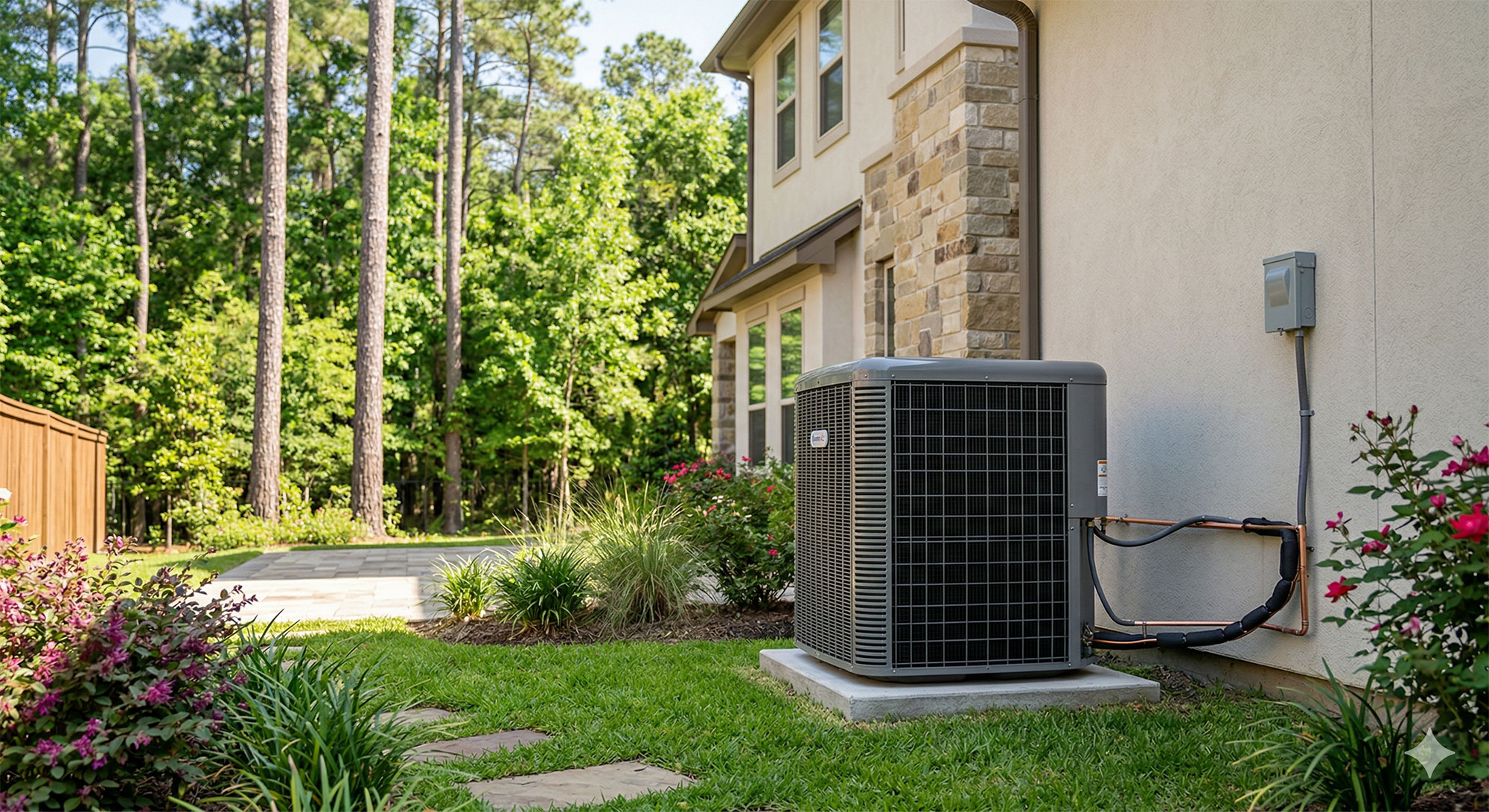
As we navigate the spring of 2026 here in The Woodlands, the familiar hum of air conditioners is already becoming the soundtrack of our neighborhoods. If you have lived in the Spring or Woodlands area for any length of time, you know that our “spring” is often just a polite term for “pre-summer.” By mid-April, the humidity is already creeping up from the Gulf, and the pine trees are shedding enough pollen to turn every white car yellow.
At Majestic AC, we have spent the last few months answering a question that seems to be on every homeowner’s mind this year: Is a high-efficiency AC actually worth the investment in 2026? The landscape of home cooling has changed dramatically in the last three years. Between new federal efficiency mandates, a total shift in the refrigerants we use, and the rising cost of electricity in Texas, the math isn’t what it used to be in 2020. This article is designed to give you the unvarnished truth, the real numbers, and the technical breakdown of whether a high-efficiency system makes sense for your home in The Woodlands.
The 2026 Efficiency Landscape: Understanding SEER2
To talk about “high efficiency” in 2026, we first have to clarify what that even means. For decades, we used the SEER (Seasonal Energy Efficiency Ratio) rating. However, as of 2023, the industry moved to SEER2. This wasn’t just a marketing name change; it was a shift in how units are tested to better reflect the reality of a Texas attic.
Old SEER tests assumed your ductwork was perfect—which, as anyone with an attic in Panther Creek or Grogan’s Mill can tell you, is rarely the case. SEER2 tests are conducted at a much higher static pressure, meaning the rating you see on a unit today is a far more accurate representation of how it will perform in a real home.
In the southern United States, the legal minimum for a new split-system air conditioner is currently 14.3 SEER2. When we talk about “high efficiency,” we are generally looking at systems that range from 18 to 22+ SEER2. These are the Ferraris of the HVAC world, but unlike a sports car, they are designed to save you money every time you turn the key.
The Hidden Cost of "Cheap" Air Conditioning
When a 15-year-old unit finally gives up the ghost during a July heatwave, the natural instinct is to look for the lowest replacement cost. In 2026, a standard “contractor grade” unit (meeting the 14.3 SEER2 minimum) is still available. It will cool your house, and it will cost significantly less upfront than a high-efficiency model.
However, in The Woodlands, we have one of the longest cooling seasons in the country. We aren’t just running our AC in July and August; we are often running it from late March through early November. Because our “runtime” is so high, a small difference in efficiency translates into a massive difference on your Entergy or CenterPoint bill.
Furthermore, 2026 marks the full implementation of the EPA’s AIM Act, which has phased out the old R-410A refrigerant in favor of new, low-GWP (Global Warming Potential) refrigerants like R-454B and R-32. If you buy a “budget” unit that was manufactured during the transition, you might find that servicing it in five years becomes an expensive headache. High-efficiency units being installed today are designed from the ground up for these new refrigerants, featuring advanced sensors and leak-detection technology that simply isn’t present in base-level models.
Why The Woodlands is the "Ultimate Test" for AC
If you lived in a dry climate like Phoenix, efficiency would be a simple matter of how much electricity it takes to drop the temperature. But The Woodlands is not Phoenix. We live in a subtropical forest. Our challenge isn’t just the heat; it’s the latent heat, more commonly known as humidity.
A standard, single-stage air conditioner is either 100% on or 100% off. It’s like a car that only has two speeds: stopped and 100 miles per hour. When a single-stage unit turns on, it blasts cold air into your home until the thermostat is satisfied, then it shuts off.
In our humid climate, this creates a “clammy” environment. Because the unit cools the air so quickly, it doesn’t run long enough to pull the moisture out of the air. You might look at your thermostat and see 72 degrees, but you still feel sticky. This often leads homeowners to “over-cool” their homes, dropping the thermostat to 68 just to feel comfortable, which sends the electric bill skyrocketing.
High-efficiency systems usually utilize variable-speed compressors. Instead of “on” or “off,” these units can run at 25%, 50%, or 100% capacity. On a typical 85-degree day in Spring, Texas, a variable-speed unit might run all afternoon at just 35% capacity. This long, slow cycle is a miracle for humidity. It constantly moves air over the cooling coils, pulling gallons of water out of your home’s atmosphere every day.
The Real Numbers for 2026: A Financial Breakdown
Let’s look at the actual math. For this comparison, we will assume a 2,500-square-foot home in The Woodlands with an average electricity rate of 17 cents per kWh (a realistic average for 2026 including delivery charges and taxes).
The Standard System (14.3 SEER2)
- Estimated Installed Cost: $8,500 – $10,500
- Average Monthly Summer Bill: $380 – $450
- Federal Tax Credit: $0 (Does not meet efficiency thresholds)
- 10-Year Estimated Energy Cost: $32,000
The High-Efficiency System (20 SEER2 Variable Speed)
- Estimated Installed Cost: $14,000 – $17,000
- Average Monthly Summer Bill: $220 – $280
- Federal Tax Credit (Section 25C): $600 (for AC) or up to $2,000 (if it’s a Heat Pump)
- Local Utility Rebates: $200 – $600
- 10-Year Estimated Energy Cost: $19,500
The Verdict on the Math
At first glance, the $6,000 price gap between the standard and high-efficiency unit looks daunting. However, when you factor in the energy savings of approximately $1,250 per year, plus the $2,000 federal tax credit available for qualifying high-efficiency heat pumps, the “payback period” is roughly 3.2 years.
Given that a well-maintained system in our area should last 12 to 15 years, you are looking at nearly a decade of pure profit. Over the life of the system, the high-efficiency unit is actually the “cheaper” option by a margin of nearly $10,000.
Tax Credits and Rebates: The 2026 Advantage
One reason 2026 is a unique year for this investment is the Inflation Reduction Act (IRA). While some of the initial buzz from 2023 has faded, the core incentives are currently at their peak efficiency.
The Section 25C Energy Efficient Home Improvement Credit allows homeowners to claim 30% of the project cost, capped at $2,000 per year for heat pumps or $600 for high-efficiency central AC. Because many of the high-efficiency systems we install at Majestic AC are technically “Air Source Heat Pumps” (which provide both elite cooling and efficient heating), most of our customers are eligible for the full $2,000 credit.
Additionally, 2026 has seen the full rollout of the HEEHRA (High-Efficiency Electric Home Rebate Act) in Texas. Depending on your household income relative to the median in Montgomery County, you could be eligible for point-of-sale rebates of up to $8,000. For families who qualify, this effectively makes a top-of-the-line, variable-speed system the same price as a budget unit.
It is important to note that these credits require specific documentation, including an AHRI Certificate that proves the indoor and outdoor units are a matched “high-efficiency” set. At Majestic AC, we handle all this paperwork for you to ensure you aren’t leaving money on the table.
The "Quality of Life" Factor
While we love talking about numbers, the primary reason our customers in The Woodlands thank us after a high-efficiency install isn’t the bank statement—it’s the comfort.
Silent Operation
Standard AC units are loud. You know the sound—the “clunk” and “whirr” that interrupts your conversation on the back patio. Because high-efficiency variable-speed units spend most of their time running at lower speeds, they are remarkably quiet. Often, you have to stand right next to the outdoor unit to even know it’s running. If your AC unit is located near a bedroom window or a backyard deck, this noise reduction is a massive lifestyle upgrade.
Consistent Temperatures
In many older homes in The Woodlands, you have “hot spots.” Maybe the kitchen is always two degrees warmer than the living room, or the master bedroom feels like a sauna while the guest room is an icebox. Single-stage units exacerbate this because they blast air and then stop, allowing heat to soak back into the rooms. Variable-speed units provide a constant, gentle flow of air that keeps the temperature within 0.5 degrees of your thermostat setting at all times.
Indoor Air Quality
Because a high-efficiency system runs more often (even if it’s at a lower power level), your air is being filtered more frequently. For families in Spring who struggle with seasonal allergies or asthma, this constant filtration—combined with the lower humidity levels—creates a significantly healthier indoor environment. Dust and pollen are trapped in the filters rather than settling on your furniture.
Maintenance: The "High-Efficiency" Catch
We would be remiss if we didn’t mention the one “downside” to high-efficiency technology: it is more complex. A standard AC unit is relatively simple, but a 2026 variable-speed system is essentially a high-powered computer that happens to move cold air.
These systems require specialized training to install and maintain. You cannot simply “eyeball” the refrigerant charge or “guess” at the airflow settings. They require precise calibration during the installation process, including:
- ACCA Manual J Load Calculation: Ensuring the unit is sized perfectly for your home’s unique footprint and insulation levels.
- Manual D Duct Design: Verifying that your existing vents can handle the static pressure requirements of a high-efficiency blower.
- A2L Certified Handling: Ensuring the new R-454B or R-32 refrigerants are handled with the specific safety protocols required by federal law.
At Majestic AC, we have invested heavily in the diagnostic tools and technician training required for these 2026 standards. If a high-efficiency system isn’t installed perfectly, it won’t actually achieve those high SEER2 ratings you paid for.
Is it a Good Move for Resale Value?
The real estate market in The Woodlands remains one of the strongest in Texas. In 2026, buyers are more energy-conscious than ever. When a prospective buyer sees a top-of-the-line, variable-speed system with a 10-year transferable warranty, it changes the conversation.
A high-efficiency AC is often viewed as a “premium” feature, much like granite countertops or hardwood floors. It tells the buyer that the home has been well-maintained and that they won’t have to worry about a $10,000+ surprise or a $500 monthly electric bill after they move in. In our experience, homeowners often recoup a significant portion of the AC investment in the final sale price of the home.
The Verdict: So, Is It Worth It?
After looking at the real numbers for 2026, our conclusion for homeowners in The Woodlands and Spring is a resounding yes—but with a few caveats.
A high-efficiency system is definitely worth it if:
- You plan to stay in your home for at least 3 to 5 more years.
- You are sensitive to humidity or have “sticky” rooms in the summer.
- You value a quiet outdoor environment for your patio or pool area.
- You want to maximize current federal tax credits before they potentially change.
A standard-efficiency system might be better if:
- You are planning to sell the home in the next 12 months.
- You are on a very strict upfront budget and do not qualify for HEEHRA rebates.
- The home is a rental property where the landlord pays for repairs but the tenant pays the electric bill (though we’d argue a happy tenant is a long-term tenant!).
At Majestic AC, we don’t believe in high-pressure sales. Our goal is to provide you with the same data we would use for our own homes. We live in this community, we breathe this (very humid) air, and we want to make sure your home is a sanctuary from the Texas heat.
If your current system is over 10 years old, or if you’ve noticed your energy bills creeping up despite your best efforts, give us a call. We can perform a full energy audit and provide a side-by-side comparison tailored specifically to your home’s layout and your family’s budget.
The heat is coming. Let’s make sure you’re ready for it with a system that works as hard as you do, without breaking the bank.