
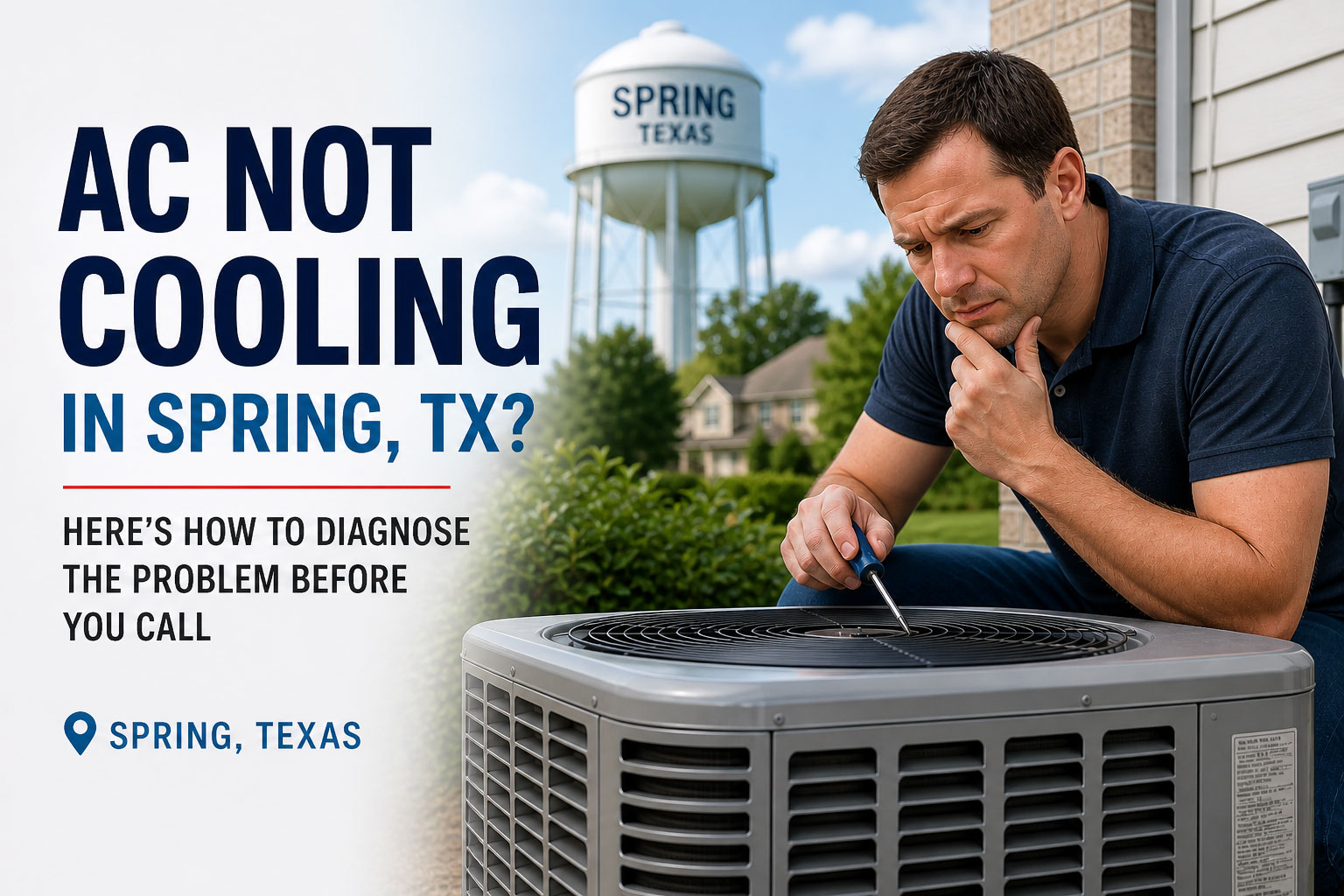
It happens to nearly every homeowner in Spring, Texas at some point. You walk inside after being out in the heat, expect that immediate wave of cool air, and instead feel — nothing. Or worse, the air coming from your vents is blowing but it’s warm. Your thermostat says 72 but it feels like 82. The AC seems to be running but the house isn’t cooling down.
That sinking feeling is familiar to anyone who has lived through a Gulf Coast summer. And the instinct to immediately pick up the phone and call for a technician is completely understandable — especially when it’s 95 degrees outside and the humidity is thick enough to wear. But before you make that call, there are several things you can check yourself that might either solve the problem entirely or give the technician much more useful information when they do arrive. Either way, a few minutes of methodical diagnosis can save you time, money, and a lot of unnecessary frustration.
This guide walks you through a logical, room-by-room, system-by-system process for figuring out what’s actually going on with your AC when it stops cooling your Spring, TX home. Some of these checks are so simple they get overlooked entirely. Others require a little more attention. None of them require any tools or technical training.
Start at the Thermostat — Every Time
It sounds almost too obvious to say, but the thermostat is where a surprising number of “AC failures” actually originate — and it should always be your first stop. Before anything else, confirm that your thermostat is set to COOL and not HEAT or OFF. Then check that the fan setting is on AUTO and not ON. When the fan is set to ON rather than AUTO, it runs continuously regardless of whether your system is actually producing cold air — which means you’ll feel airflow from the vents even when your AC isn’t running a cooling cycle. Homeowners often mistake this for the AC running normally when it actually isn’t cooling at all.
Next, check your setpoint temperature. Make sure it’s set at least three to four degrees below your current indoor temperature. If the thermostat reads 76 and you have it set to 75, some systems won’t initiate a cooling cycle for such a small differential. Drop the setpoint to 70 and wait a few minutes to see if the system kicks on.
If you have a smart thermostat, check the app or display for any alerts or error codes. Devices like Ecobee and Nest will often tell you directly if something is wrong — a communication error, a tripped safety sensor, or a scheduling conflict that has inadvertently put your system in an away or eco mode. A quick reset of the thermostat by removing it from its base for 30 seconds and reattaching it resolves connectivity issues more often than people expect.
Finally, check the batteries if your thermostat uses them. A thermostat with dying batteries can behave erratically, fail to communicate with your system properly, or display incorrect readings.
Check Your Air Filter
The air filter is the single most common cause of reduced cooling performance in residential HVAC systems, and it’s the one that homeowners are most likely to forget about. In Spring, Texas — where pollen counts run high in spring, humidity encourages biological growth year-round, and homes are often sealed tight against the heat — air filters can become heavily clogged faster than the standard recommendation of every 30 to 90 days.
A severely restricted filter doesn’t just reduce airflow through your vents. It starves the evaporator coil of the return air it needs to absorb heat from your home, which can cause the coil to freeze over. A frozen evaporator coil will produce little to no cooling and can eventually cause water damage when it thaws. If your AC is running but barely keeping up, or if you’ve noticed ice forming on the refrigerant line near your indoor unit, a clogged filter is often the first place to look.
Pull the filter out and hold it up to the light. If you can’t see light passing through it, it needs to be replaced immediately. This is a fix that costs a few dollars and takes two minutes, but it can restore your system’s performance entirely if restricted airflow was the root cause. After replacing the filter, if your coil had started to freeze, turn your system to fan-only mode for an hour or two to let it thaw completely before switching back to cooling.
Look at Your Circuit Breaker Panel
Your air conditioning system actually runs on two separate circuits — one for the indoor air handler or furnace, and one for the outdoor condenser unit. It’s entirely possible for one of those circuits to trip while the other stays on, which can produce confusing symptoms. You might hear the indoor blower running and feel air coming from your vents, but have no cooling because the outdoor unit — which contains the compressor and does the actual work of removing heat from your home — has lost power.
Go to your home’s main electrical panel and look for any breakers that are in a tripped position, which typically sits partway between ON and OFF rather than fully in either direction. If you find one related to your AC or HVAC system, reset it by pushing it firmly to OFF first, then back to ON. Wait a few minutes and see if your system restores normal operation.
One important caution here: if a breaker trips again shortly after you reset it, do not keep resetting it. A breaker that trips repeatedly is telling you something — there’s a fault, an overload, or a short circuit somewhere in the system that needs professional diagnosis. Repeatedly forcing a tripped breaker back on can cause serious electrical damage or create a fire hazard. Note how long it takes to trip again and share that information with your technician — it will be useful.
Check the Outdoor Condenser Unit
Walk outside and take a look at your outdoor condenser unit. There are several things you can observe without touching anything that will tell you a lot about what’s happening with your system.
First, is the unit running at all? If the outdoor unit is completely silent and still while the indoor air handler is running, that points to an electrical issue — either the breaker mentioned above, a failed capacitor, or a problem with the contactor that controls power to the compressor and fan. These are among the most common mechanical failures in Houston-area AC systems and almost always require a technician to resolve, but knowing the outdoor unit isn’t running gives the technician a clear diagnostic starting point.
If the outdoor unit is running, listen to how it sounds. A healthy condenser runs with a steady hum. A loud rattling or banging sound suggests debris inside the unit or a fan blade issue. A high-pitched squealing or grinding sound often indicates a failing fan motor bearing. A clicking or intermittent cycling sound — where the unit tries to start, stutters, and shuts back off — is a classic symptom of a weak capacitor struggling to get the compressor started. All of these are conditions your technician needs to know about.
Also look at the condition of the unit itself. If the fins on the condenser coil — the metal grating on the sides of the unit — are heavily packed with cottonwood, grass clippings, or debris, your unit may be overheating and going into thermal shutdown as a safety measure. You can gently rinse the outside of the fins with a garden hose on a low-pressure setting, spraying from the inside out if possible, but avoid using a pressure washer, which can damage the delicate fins. Clearing this debris can sometimes restore operation immediately.
Check that there’s adequate clearance around the unit as well. Vegetation that has grown too close over the winter and spring can restrict airflow. Two feet of clearance on all sides is the general rule.
Evaluate the Airflow in Your Home
If your system is running — both the indoor and outdoor units appear to be operating — but your home still isn’t cooling, the problem may be related to how air is moving through your house rather than with the AC system itself.
Walk through each room and hold your hand up to the supply vents in the ceiling or floor. Is air coming out of every vent? Is the airflow strong and consistent, or weak in some rooms and nonexistent in others? Uneven airflow can indicate a duct issue — a disconnected duct in the attic, a damper that’s in the wrong position, or a section of ductwork that has collapsed. In Spring-area homes with attic ductwork, temperature extremes and age can cause flex duct to sag, kink, or detach from boots over time, sending your conditioned air directly into the attic instead of into your living space.
Make sure all of your supply and return vents are open and unobstructed. It’s a common misconception that closing vents in unused rooms saves energy — in a forced-air system, closing vents actually increases static pressure in the ductwork, reduces efficiency, and can cause the system to work harder than it should. If several vents in your home are closed, open them and see if your cooling performance improves.
Also check that your return air vents aren’t blocked by furniture. The return vents — typically larger grilles without visible louvers — need clear access to pull air back into the system. A couch, bookshelf, or area rug sitting in front of a return vent can meaningfully reduce your system’s ability to circulate air properly.
Consider How Long Your System Has Been Running
There’s an important distinction between an AC system that won’t cool at all and one that’s cooling but can’t keep up with the heat. On the hottest days of a Spring, Texas summer — days where the heat index is above 105 — even a well-functioning AC system may struggle to keep your home more than 20 degrees cooler than the outdoor temperature. That’s not a malfunction; it’s physics. A system sized for average conditions working against extreme heat will run continuously and may still allow the indoor temperature to creep up a few degrees during peak afternoon hours.
If your system is cooling but can’t reach your setpoint on an extreme heat day, that doesn’t necessarily mean something is wrong. If it’s struggling to maintain temperature on a normal 90-degree day, or if it’s running constantly without making meaningful progress, that’s a different story and warrants a closer look — particularly at refrigerant charge and coil cleanliness, which require a professional to assess.
What to Tell Your Technician When You Call
If you’ve worked through all of the above and your system still isn’t cooling properly, it’s time to call a professional. When you do, the information you’ve gathered will make the service call faster and more efficient. Before you dial, take note of a few things: how long the problem has been occurring, whether both the indoor and outdoor units appear to be running, any unusual sounds or smells you’ve noticed, the age of your system if you know it, and when your filter was last changed. A technician who arrives with that context can often diagnose and resolve the issue in a single visit rather than spending the first half hour gathering information.
It also helps to take a photo of the rating plate on your outdoor condenser unit — the metal label affixed to the side of the cabinet that lists the model number, serial number, and specifications. This information tells a technician immediately what they’re working on, what refrigerant your system uses, and when it was manufactured. Majestic AC’s online service request form even has an optional field to upload this photo before a technician arrives, which is something we encourage because it genuinely speeds up the service process.
When to Call Immediately Without Diagnosing
There are a handful of situations where you should skip the diagnostic process and call for service right away. If you smell burning plastic or electrical odors coming from any part of your system, shut it off at the thermostat and call immediately — that’s a potential electrical hazard. If you see water actively dripping from your indoor unit or pooling on the floor beneath it, turn the system off to prevent further water damage and call for service. If you notice ice forming anywhere on your indoor unit or refrigerant lines, turn the system to fan-only to thaw the coil and call for an appointment — a frozen coil is always a symptom of an underlying issue that needs professional attention.
And if your home has elderly family members, young children, or anyone with a medical condition that makes heat dangerous, don’t spend time on self-diagnosis. Call for emergency service directly. Getting your household to a safe temperature is the priority, and a good HVAC company will treat those situations accordingly.
Majestic AC Is Here When You Need Us
Majestic AC has been serving Spring, Texas and surrounding communities for over three generations. We run fully-stocked trucks dispatched by GPS so that most repair calls are completed the same day. We’ll send you a text when your technician is on the way, and we back every repair with a 100% satisfaction guarantee in writing.
If your AC isn’t cooling and you’ve worked through the steps above without a resolution, give us a call at (281) 376-2224 or schedule online. We’ll get someone out to you quickly — because in a Texas summer, a home without air conditioning isn’t just uncomfortable. It’s urgent.