
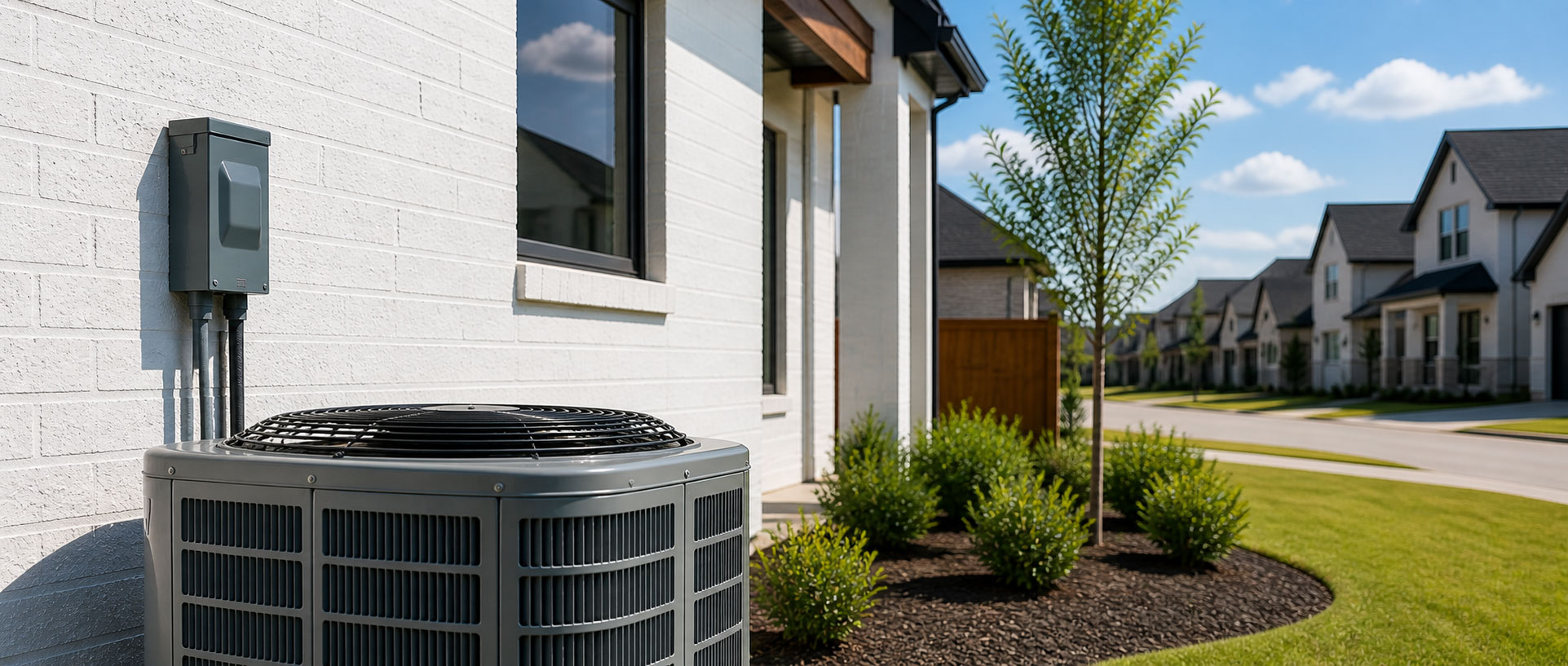
Moving into a brand-new home in Spring, Texas feels like a fresh start in every sense of the word. New floors, new appliances, new walls — and a brand-new HVAC system sitting in the attic and outside in the yard that you’ve probably never thought much about. Why would you? Everything is new. It should all work fine for years, right?
The reality is more complicated, and it’s something we see play out regularly across the new construction communities throughout the Spring, Klein, and Tomball areas. New HVAC systems in new homes are not the same as a new TV or a new refrigerator. They require attention, maintenance, and a baseline understanding from the homeowner if they’re going to perform the way they’re supposed to — especially in a climate as demanding as ours. And unlike a malfunctioning appliance you can simply return to a store, an HVAC system that’s been neglected or misunderstood from day one can cost thousands of dollars to correct and may even affect your builder’s warranty coverage if you’re not careful.
This guide is written specifically for new construction homeowners in the Spring, TX area — people who are starting from scratch with a system they may know very little about. Understanding these fundamentals now will save you real money, protect your warranty, and keep your family comfortable through every season Harris County throws at you.
Your New System Was Sized for Your Home — But Was It Done Right?
One of the most common issues we encounter in new construction homes is improper system sizing, and it’s one that homeowners rarely suspect because the system is brand new and appears to be working. HVAC sizing isn’t simply a matter of matching a system to the square footage of a home. A proper load calculation — called a Manual J in the industry — accounts for the home’s orientation, ceiling height, insulation values, window placement and efficiency, local climate data, and a dozen other variables that determine how much heating and cooling capacity the home actually requires.
Builders work under tight cost and schedule pressures, and their HVAC subcontractors sometimes default to quick rules of thumb rather than proper load calculations. The result can be a system that’s either too large or too small for the home it’s installed in, and both scenarios cause real problems.
An oversized system — one that’s too powerful for the home — will cool the space quickly but shut off before it has run long enough to properly dehumidify the air. In Spring, Texas, where summer humidity is relentless, this creates a home that feels cool on the thermostat but damp and clammy in reality. It also causes excessive wear on the system from the frequent on-off cycling. An undersized system, on the other hand, will run nearly continuously during peak summer heat without ever fully reaching your setpoint, driving up energy bills and shortening the system’s lifespan through overwork.
If your new home feels excessively humid even when the AC is running, or if your system seems to cycle on and off very frequently in short bursts, it’s worth having an independent HVAC professional evaluate whether your system was properly sized. Catching this early — ideally in the first year while builder warranties are still in effect — gives you the best chance of getting it corrected at no cost to you.
Understand What Your Builder Warranty Actually Covers
New construction homes in Texas typically come with a one-year workmanship warranty from the builder, a two-year warranty on mechanical systems including HVAC, and a ten-year structural warranty under state law. But the equipment warranty on your HVAC system itself — the manufacturer’s warranty on the actual unit — is a separate matter, and how you maintain the system during the warranty period can directly affect whether a claim is honored.
Most HVAC manufacturers require documented proof of regular professional maintenance to honor warranty claims on parts and labor. If your compressor fails in year four and you have no maintenance records, the manufacturer may deny the claim on the grounds that the failure resulted from neglect. This is not a hypothetical — it happens, and it leaves homeowners with a significant repair or replacement bill that should have been covered.
From your very first year in a new home, keep a simple record of every service visit, filter change, and any work performed on your system. A folder in a filing cabinet or a note in your phone is enough. When you have a professional perform a tune-up, ask for a written service report and hold onto it. This documentation is the evidence that protects you if something goes wrong during the warranty period.
It’s also worth reading through the warranty documentation that came with your system to understand what voids coverage. Using non-approved refrigerant, running the system without a filter, or allowing a non-licensed technician to perform repairs are common exclusions. Knowing these in advance prevents accidental missteps that could cost you thousands in uncovered repairs.
The First Year Is Critical for Catching Installation Issues
A new HVAC system going through its first full year of operation in a new home is essentially being stress-tested for the first time. The installation process involves dozens of connection points, refrigerant line fittings, electrical connections, and duct connections that all need to seal and settle properly. In a significant percentage of new construction installs, minor issues surface during this first year that weren’t apparent during the builder’s walkthrough — small refrigerant leaks at flare fittings, ductwork connections that weren’t fully secured, or condensate drain lines that weren’t properly sloped.
These issues are typically minor and inexpensive to fix if caught early. The challenge is that they often don’t cause dramatic, obvious symptoms right away. A slow refrigerant leak may take a full summer to reduce your charge enough to noticeably affect cooling performance. A slightly loose duct connection might only reveal itself when you notice that one room is consistently warmer than the rest of the house.
Scheduling a professional inspection and tune-up after your first full summer of operation — and again after your first winter — is one of the best investments you can make as a new construction homeowner. A trained technician will measure your refrigerant charge to ensure it matches the manufacturer’s specification, verify that all duct connections are secure, confirm that your condensate drain is flowing properly, and check electrical connections that may have loosened during shipping and installation. Most importantly, if they find anything that should have been done correctly by the installing contractor, you’ll still be within your builder’s warranty period to have it addressed at no cost.
Your Ductwork Is Hidden — But It Matters More Than You Think
In virtually every new construction home in the Spring, TX area, the ductwork runs through the attic. This is standard practice in our region, but it comes with a challenge that many new homeowners don’t anticipate: attic temperatures in a Texas summer can exceed 140 degrees Fahrenheit. Every foot of duct running through that environment is a potential energy loss, because even insulated ductwork transfers some heat from the surrounding attic air into the cool air passing through it on its way to your living space.
The quality of ductwork installation varies considerably among builders and their HVAC subcontractors. Properly installed flex duct should be fully extended without sags or kinks, securely fastened at all connection points, and thoroughly insulated at every seam and boot connection. Shortcuts taken during installation — and they do happen under production pressure — can result in ductwork that leaks conditioned air into the attic rather than delivering it to your rooms, or that transfers excessive heat into the air stream before it ever reaches your vents.
If you notice that certain rooms in your home are consistently harder to cool than others, or if your energy bills seem higher than neighbors in similar homes, ductwork quality is worth investigating. A duct leakage test — something a qualified HVAC technician can perform — will tell you precisely how much of your conditioned air is making it to your living space versus escaping into the attic. In some new construction homes, this number is surprisingly low, and sealing the ductwork can dramatically improve both comfort and energy efficiency.
Air Filters: The One Maintenance Task That's Entirely in Your Hands
Of all the things that determine how well your new HVAC system performs over its lifetime, filter maintenance is the one that falls entirely to you as the homeowner — and it’s the one that has the most immediate and measurable impact on system health and indoor air quality.
New construction homes present a particular air quality challenge that many first-time homeowners don’t anticipate. During construction, enormous amounts of drywall dust, sawdust, insulation fibers, and construction debris accumulate throughout the structure. Much of this settles in the ductwork and on surfaces before you ever move in. When your system starts running, it pulls all of that particulate matter through your air handler and into your filter. New construction homes routinely go through filters two to three times faster than established homes in the first year for exactly this reason.
Check your filter monthly for at least the first year. Don’t rely on the 90-day guidance printed on the packaging — that’s written for average conditions, and a new construction home in the first year of operation is not average conditions. A filter that’s visibly clogged is already affecting your system’s performance and the air quality in your home. Replacing it takes two minutes and costs a few dollars. Ignoring it can lead to a frozen evaporator coil, reduced airflow, and eventual damage to your blower motor.
While you’re at it, the first year in a new home is a good time to identify where all of your return air vents are located and make sure your furniture arrangement doesn’t block them. Builders place return vents based on the home’s design, not on where you’re going to put your couch — and a blocked return vent is a surprisingly common source of airflow problems in new homes.
Humidity Control Is as Important as Temperature in Our Climate
If you’ve moved to Spring, Texas from a drier climate, the humidity is going to require an adjustment in how you think about home comfort. In most of the country, setting your thermostat to 72 degrees means a comfortable 72 degrees. In Southeast Texas, 72 degrees at 65% relative humidity feels noticeably different from 72 degrees at 45% relative humidity — and the difference matters for everything from how comfortable you feel to whether you see condensation on your windows or smell mustiness in your closets.
A properly functioning and properly sized AC system will dehumidify your home as it cools it, but it can only do so much. During the shoulder seasons — spring and fall — when outdoor temperatures are mild but humidity is still high, your AC may not run long enough to adequately dehumidify your home even though the temperature is comfortable. This is when many Spring-area homeowners discover they need a whole-home dehumidifier to maintain the relative humidity in the 45-55% range that’s ideal for both comfort and home health.
New construction homes are also typically built very tight for energy efficiency purposes, which is a good thing in terms of heating and cooling costs but can trap moisture inside if the home’s ventilation isn’t properly balanced. If you notice condensation on windows, a musty smell in any part of the house, or visible humidity-related issues in your first year, don’t assume it’s a construction defect before having an HVAC professional evaluate your system’s dehumidification performance. In many cases, a simple equipment addition resolves what seems like a major problem.
Get to Know Your System Before You Need It
One of the best things a new construction homeowner can do in the first few months of occupancy is simply learn the basics of their specific HVAC system before anything goes wrong.
- Know where your filter is located and how to change it.
- Know where your indoor air handler is and where the emergency shutoff switch is — it’s typically a red switch near the unit that looks like a light switch.
- Know where your condensate drain pan is and what it looks like when it’s holding standing water, which indicates a clogged drain line.
- Know how to locate your circuit breaker panel and identify which breakers control your HVAC system.
None of this requires any technical skill. It’s simply the home literacy that helps you respond appropriately when something feels off, communicate clearly with a technician when you call for service, and avoid small problems becoming expensive ones because you didn’t recognize the warning signs.
Taking 30 minutes to walk through your home with a new HVAC technician during a first-year inspection is one of the highest-value uses of that time. A good technician will show you everything mentioned above, answer your questions, and leave you with a clear picture of the system you’re responsible for maintaining. That knowledge is worth more than any single repair.
Why a Local Expert Matters More in a New Build
National home warranty companies and builder-referred HVAC contractors serve their own interests first. When something goes wrong with your system in year one or two, having an established relationship with a local, independent HVAC company means you have someone in your corner who can objectively evaluate whether an issue is a warranty matter, an installation defect, or a maintenance-related problem — and help you navigate the conversation with your builder accordingly.
Majestic AC has been serving Spring, Texas and surrounding communities for over three generations. We’ve inspected hundreds of new construction HVAC systems across the Spring, Klein, and Tomball areas, and we know exactly what to look for in the first years of a system’s life. We don’t have any financial relationship with builders or their subcontractors, which means our assessment of your system is completely objective. If something was installed incorrectly, we’ll tell you — and we’ll help you document it so you can pursue the appropriate warranty remedy.
If you’ve recently moved into a new construction home in Spring, TX and haven’t had your HVAC system independently inspected, give us a call at (281) 376-2224 or schedule online. A first-year inspection is one of the smartest investments you can make in your new home — and it’s a whole lot less expensive than the problems it can prevent.