
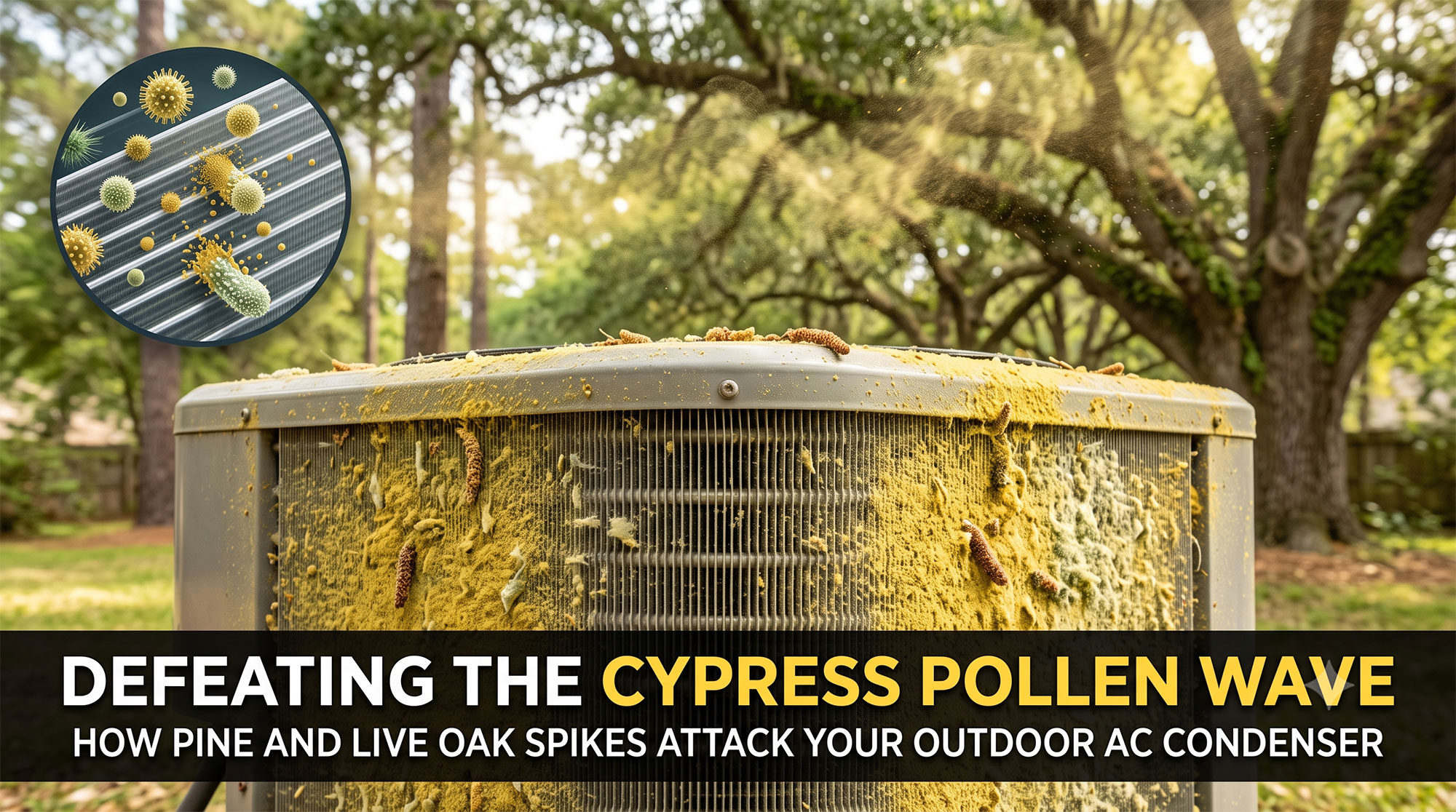
If you live anywhere along the Spring-Cypress corridor, Barker Cypress, or deep within master-planned communities like Bridgeland and Fairfield, you are intimately familiar with the seasonal yellow blanket. Every spring and late summer, the dense canopy of loblolly pines and sprawling live oaks that gives northwest Harris County its scenic charm unleashes a microscopic assault. For residents, it means itchy eyes, sneezing fit marathons, and a daily routine of hose-spraying yellow dust off windshields.
However, your respiratory system isn’t the only thing taking a beating during these regional botanical cycles. Just a few feet outside your home, sitting quietly on a concrete pad, your air conditioning system’s outdoor condenser unit is inhaling that very same air.
While most homeowners understand that air filters inside the house need regular changes to manage indoor air quality, the outdoor portion of the HVAC system is often left to fend for itself. In Cypress, Texas, where the combination of high humidity and explosive tree pollen creates a literal glue, ignoring your outdoor condenser during a pollen spike is a recipe for skyrocketing utility bills, premature component failure, and unexpected system shutdowns in the dead of summer.
The Role of Gulf Coast Humidity
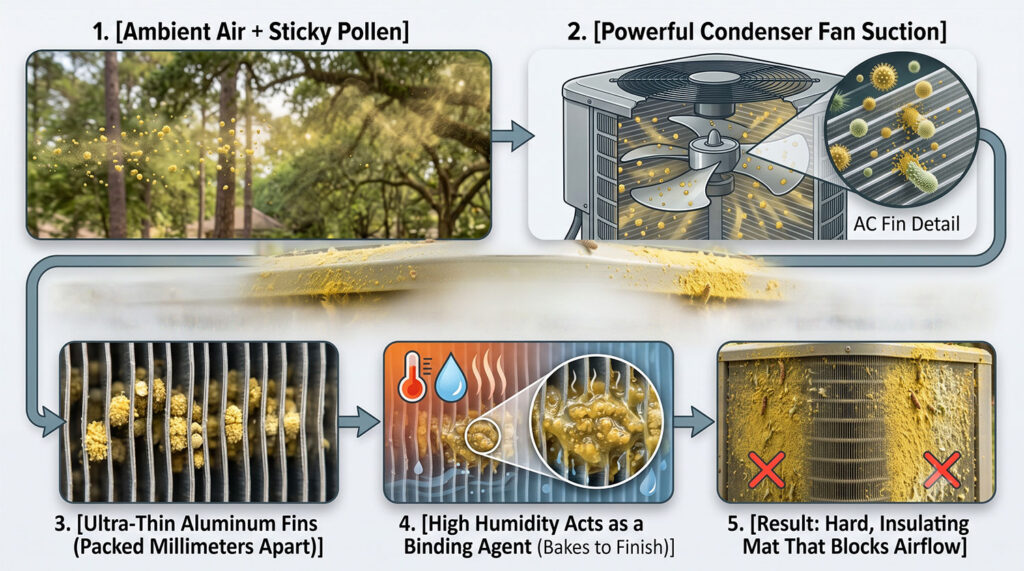
If the weather during a Cypress spring were perfectly dry, a significant portion of this pollen might simply pass through the cabinet or shake loose when the system cycles off. However, southeast Texas humidity changes the physics entirely. The air in Cypress is consistently laden with moisture, especially during the early morning hours when pollen release is often at its highest.
When dry pollen particles hit a damp, moisture-wicking metal coil surface, they hydrate and become intensely sticky. As the afternoon sun heats the air and the AC unit runs continuously, this damp pollen slurry is baked directly onto the aluminum fins. Over several weeks, this cycle creates a hard, crusty, insulating barrier that cannot be removed by a simple breeze.
The Mechanical Toll: From Restricted Airflow to Broken Parts
When a layer of baked-on pollen blocks the microscopic gaps between your condenser fins, your air conditioner enters a state of chronic mechanical stress. The consequences of this stress ripple through the entire system, leading to short-term financial pain and long-term mechanical breakdown.
The Insulating Blanket Effect
Aluminum is chosen for condenser fins because it has an exceptionally high thermal conductivity, meaning it transfers heat out of the refrigerant paths very quickly. Pollen, on the other hand, is an organic material that acts as a natural insulator. When a layer of pollen coats the aluminum, it prevents the ambient air from making direct contact with the metal.
Because the heat cannot escape efficiently, the refrigerant leaving the outdoor unit remains much hotter and under higher pressure than the system was designed to handle. Inside the home, this manifests as a system that runs for hours on end without ever truly satisfying the thermostat, blowing lukewarm or moderately cool air instead of the crisp, refreshing stream you expect.
Overworking the Compressor
The compressor is the heart of your HVAC system, and it is by far the most expensive component to replace. It relies on the returning cool refrigerant to keep its internal motor windings from overheating. When a pollen-choked condenser fails to drop the refrigerant temperature, the compressor is forced to work against dangerously high head pressures while running significantly hotter than its engineered limits.
This continuous thermal overload degrades the compressor’s internal lubricating oil, breaking it down into an acidic sludge. Over time, this accelerated wear leads to mechanical locking or an electrical short-circuit, commonly referred to as a burned-out compressor.
Cap Fatigations and Electrical Strains
The extra work required to push air through a blocked coil also takes a heavy toll on the electrical components inside the outdoor cabinet, most notably the dual run capacitor. The capacitor acts like a temporary storage battery, providing the continuous electrical phase shift needed to keep both the fan motor and the compressor running smoothly.
When the system is running hot and under high pressure, the current draw spikes. This increased electrical resistance generates internal heat within the capacitor, causing it to swell, leak its dielectric fluid, and eventually fail. A failed capacitor is one of the most common reasons Cypress homeowners wake up to an AC unit that is humming loudly but refusing to blow cool air.
Calculating the Cost: The Sneaky Electric Bill Spike
The mechanical damage caused by a pollen-coated condenser happens gradually, but the financial penalty hits your wallet immediately. Because an air conditioner with a blocked coil has to run significantly longer to achieve the same cooling effect inside the home, your electrical consumption tracks upward dramatically.
Consider the baseline mechanics of a standard three-ton residential AC system. Under normal operating conditions with a clean outdoor coil, the system might run for twenty minutes to drop an average-sized Cypress home’s indoor temperature by two degrees, consuming a predictable amount of kilowatt-hours.
If that same unit has its outdoor airflow reduced by just twenty percent due to a crust of baked oak and pine pollen, the heat rejection process slows down to a crawl. Now, the system must run for forty-five minutes to achieve that exact same two-degree drop.
This extended runtime means your compressor and fan motor are drawing high-amperage power for more than twice as long as necessary. In southeast Texas, where summer electricity bills are already a major household expense, an uncleaned, pollen-choked condenser can easily add thirty to fifty percent to your monthly cooling costs. You are essentially paying a premium price to run a crippled machine that is actively wearing itself out.
The DIY Cleaning Trap: How Well-Meaning Homeowners Damage Their Systems
When homeowners realize their outdoor unit is caked in yellow dust, the instinctive reaction is to grab a garden hose or a pressure washer and go to work. While maintaining a clean coil is vital, improper cleaning techniques can cause instantaneous, irreversible physical damage to the equipment.
The most dangerous tool in the hands of a well-meaning homeowner is a high-pressure washer. The aluminum fins on an outdoor condenser are incredibly delicate, often measuring less than a fraction of a millimeter in thickness. The concentrated, high-velocity stream from a pressure washer nozzle will slice through a layer of pollen, but it will also instantly flatten and bend the aluminum fins flat against each other.
When fins are flattened, airflow is permanently blocked in that section of the coil. Correcting flattened fins requires a tedious, manual process using a specialized tool called a fin comb to straighten each individual metal tooth. In severe cases, a pressure washer can bend so many fins that the entire outdoor coil must be replaced, transforming a simple cleaning chore into a multi-thousand-dollar repair bill.
Another common mistake is the indiscriminate use of household chemical cleaners. Many online tutorials suggest using caustic degreasers, laundry detergents, or acid-based wheel cleaners to dissolve outdoor grime. However, many household chemicals react aggressively with aluminum and copper.
An improper chemical application can trigger rapid galvanic corrosion, pitting the metal surfaces and eating away at the microscopic braze joints where the copper tubes meet the aluminum fins. This corrosion inevitably leads to microscopic refrigerant leaks that are incredibly difficult to locate and highly costly to fix.
The Safe, Step-by-Step Homeowner Rinse Protocol
You can absolutely safely manage basic surface pollen accumulation between professional maintenance visits. If you notice a visible yellow film forming on your unit during the peak of the Cypress tree pollen spikes, follow this safe, low-pressure rinsing protocol to keep the system breathing.
1. Cut the Power for Safety
Before you introduce any water to the outdoor unit, you must completely isolate it from its electrical source. Locate the metal disconnect box mounted on the exterior wall of your home near the condenser. Open the weatherproof door and pull the plastic disconnect plug straight out, or flip the internal circuit breaker to the “Off” position. Verify the power is off by listening to ensure the unit is completely silent and no internal components are humming.
2. Clear Away Exterior Vegetation
Pollen isn’t the only thing that restricts airflow. Take a moment to clear away any physical obstructions around the unit’s perimeter. Cut back wild weeds, ornamental grasses, or low-hanging tree branches to maintain at least a two-foot clear boundary entirely around the condenser pad. This open space prevents air restriction and reduces the volume of localized organic matter the unit pulls against its sides.
3. Use a Gentle, Low-Pressure Spray
Attach a standard adjustable spray nozzle to your garden hose and set it to a gentle “rinse” or “shower” pattern. Never use a jet stream setting. Stand roughly two feet away from the unit and direct the water spray at a downward forty-five-degree angle against the sides of the metal cabinet.
4. Wash Top to Bottom
Always work from the top of the coil down to the base. This directional washing ensures that the melting pollen slurry flows downward out of the bottom drainage tracks of the cabinet rather than getting pushed deeper into the center of the machine. Continue rinsing until the water running out from the bottom of the metal base pan runs completely clear of yellow or brown discoloration.
5. Restore Power and Monitor
Allow the exterior cabinet to drip dry for roughly fifteen minutes. Once dry, slide the electrical disconnect plug back into its slot or flip the circuit breaker back to the “On” position. Listen closely as the system restarts to ensure the fan spins up smoothly without any unusual vibration, which can sometimes happen if heavy debris was dislodged onto the fan blades.
When to Call the Pros: The Limits of a Garden Hose
While a periodic DIY rinse with a garden hose is an excellent way to manage surface dust, it is not a substitute for a professional technical cleaning. A standard garden hose simply lacks the ability to dissolve the deep, chemically bonded organic matrix that forms when pollen mixes with Gulf Coast humidity, environmental smog, and lawn mower clippings.
When an HVAC professional services a pollen-choked unit, they utilize specialized, self-foaming, non-acidic chemical coil cleaners that are specifically engineered to be safe on HVAC metals. These professional-grade solutions are sprayed deep into the interior core of the coil matrix. As the chemical activates, it creates a powerful, expanding foam action that pushes outward from the inside of the unit, lifting the deeply embedded, baked-on pollen blocks out of the microscopic spaces between the fins.
Furthermore, a professional maintenance visit goes far beyond a simple surface wash. A certified technician will open the electrical control panel to inspect the contactor faces for pitting and test the electrical health of your dual run capacitor using a multimeter to check its exact microfarad output.
They will check the total amperage draw of your compressor motor to ensure it is operating within factory specifications, check the system’s exact refrigerant charge levels, and inspect the internal fan motor bearings for signs of heat wear. This holistic inspection catches the hidden damage caused by pollen seasons before it transitions into a catastrophic system failure on a blistering hot afternoon.
A Local Approach to Year-Round System Protection
Living in the wooded beauty of Cypress, Texas, means accepting that seasonal pollen waves are an unavoidable part of our local environment. The pines and live oaks will continue their reproductive cycles every year, and our regional humidity isn’t going anywhere.
By understanding how this local environmental reality directly threatens your home’s air conditioning system, you can move from a reactive mindset of calling for repairs after a breakdown to a proactive mindset of seasonal preservation.
Treat your outdoor condenser with the same care you give your indoor filters. Keep the perimeter clear, perform gentle low-pressure rinses when the yellow dust begins to pile up, and partner with a trusted local professional to deep-clean the internal mechanics before the brutal summer heat demands peak performance from your system. Protecting your air conditioner from the Cypress pollen wave preserves your comfort, slashes your monthly utility bills, and extends the operational lifespan of your home’s most vital mechanical investment.
Proximity & Service Area Note:
While our primary service center is located just down the road in Spring, Majestic AC’s wrapped service trucks are everyday fixtures along U.S. 290, Barker Cypress, and Spring Cypress Road. Our certified technicians live and work throughout northwest Harris County, providing the hyper-local expertise needed to protect Cypress homes from our unique regional climate and environmental challenges.