
Quick Read
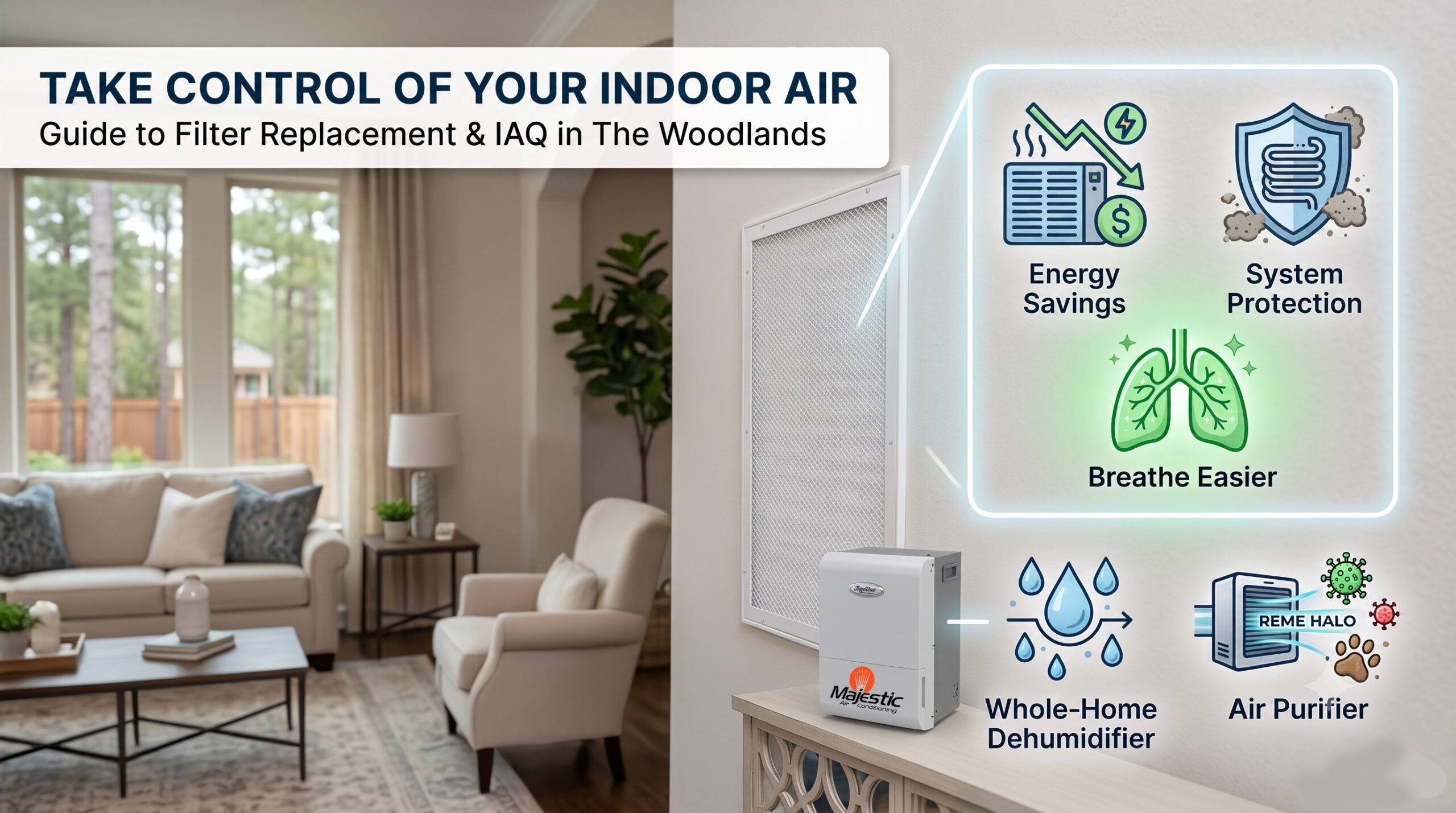
For homeowners in The Woodlands, Texas, maintaining clean indoor air is a continuous battle. The region’s lush pine canopy, high humidity levels, and extended cooling seasons mean residential HVAC systems run hundreds of hours each month. Replacing your HVAC air filter regularly is the single most effective, cost-efficient maintenance step you can take to protect your family’s health, lower monthly energy costs, and prevent system breakdowns.
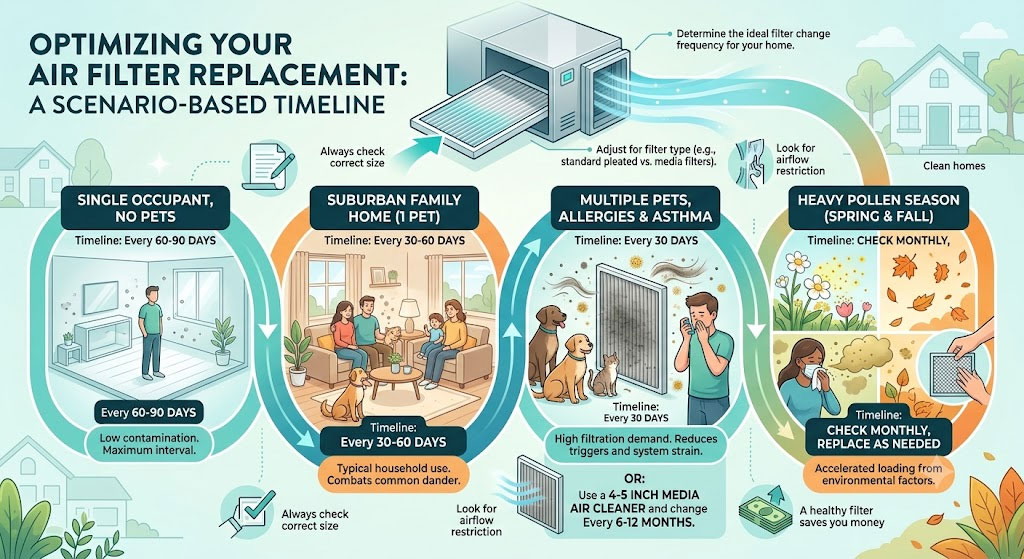
- Recommended Filter Change Frequency: Every 30 to 90 days for standard 1-inch pleated filters; every 6 to 12 months for 4- to 5-inch media filters.
- Optimal MERV Rating for Local Homes: MERV 8 to MERV 13 balances micro-particle capture with proper HVAC airflow.
- Next-Level IAQ Upgrades: Whole-home in-duct air purifiers (such as UV lights or REME HALO® systems) and whole-home dehumidifiers work alongside your air filter to eliminate VOCs, mold spores, viruses, and excess humidity.
The Air Quality Reality in The Woodlands, TX
Living in master-planned communities across The Woodlands—from Grogan’s Mill and Panther Creek to Alden Bridge, Sterling Ridge, and Creekside Park—offers incredible piney woods scenery. However, that natural environment presents specific air quality challenges inside modern homes:
- Heavy Seasonal Pollen Load: The heavy pine trees, live oaks, ragweed, and native grasses produce excessive airborne pollen throughout spring, summer, and autumn.
- Year-Round High Humidity: Relative humidity in Montgomery County routinely exceeds 80% to 90% during morning hours. Uncontrolled moisture inside air ducts and living spaces creates prime breeding conditions for mold spores, dust mites, and mildew.
- High HVAC Run Times: Texas summers demand near-continuous air conditioner operation. As air recirculates through your ductwork multiple times per hour, uncaptured dust, dander, and bio-contaminants accumulate rapidly.
- Tightly Sealed Home Envelopes: Modern energy-efficient homes keep outdoor air out, but they also trap indoor pollutants—such as volatile organic compounds (VOCs) from household cleaners, cooking fumes, pet dander, and off-gassing furniture.
Your HVAC air filter sits at the front line of defense, filtering hundreds of thousands of cubic feet of air every day.
Top 5 Benefits of Regular Air Filter Replacement
1. Substantial Energy Savings & Lower Utility Bills
When an air filter becomes clogged with dust, dirt, and pet hair, your HVAC system’s blower motor must work significantly harder to pull air through the restricted surface. This added static pressure forces the AC system to draw more electricity to deliver the same level of cooling.
According to the U.S. Department of Energy, replacing a dirty, clogged air filter with a clean one can reduce your air conditioner’s energy consumption by 5% to 15%. In the heat of a South Texas summer, that reduction translates directly into noticeable savings on your monthly electric bill.
2. Prevention of Costly System Breakdowns & Coil Freezing
A restricted air filter starves your air conditioner’s evaporator coil of adequate airflow. When warm indoor air cannot pass freely across the cooling coil, the refrigerant inside cannot absorb heat efficiently. As a result:
- The evaporator coil temperature drops below freezing.
- Condensation on the coil turns to ice, eventually encasing the entire system in a block of ice.
- Liquid refrigerant can flow back into the compressor, causing catastrophic mechanical failure.
Regular filter changes prevent frozen coils, overheated blower motors, and unexpected emergency repair calls during 100°F heatwaves.
3. Reduced Indoor Allergy & Asthma Triggers
For allergy sufferers in The Woodlands, indoor air can quickly become more irritating than outdoor air. Clean, high-efficiency filters capture particulate matter before it can re-circulate into your bedrooms and living areas, including:
- Pine and oak pollen grains
- Dust mite debris
- Pet dander and hair
- Mold and fungal spores
- Fine environmental dust
By trapping these irritants on the filter media, family members experience fewer morning headaches, less congestion, and improved sleep quality.
4. Cleaner Home Interior & Less Dusting
Do you feel like dust settles on your countertops, furniture, and baseboards just hours after cleaning? A saturated or improper air filter allows fine particulate matter to pass directly through the return vents, blowing dust right back into your living space. Keeping a fresh filter in place traps dust at the air handler, keeping your surfaces cleaner for longer.
5. Protection of Internal System Components
Dust and debris that slip past a missing or dirty air filter collect on critical internal components:
- Blower Motor Wheel: Dust buildup on fan blades reduces airflow volume and places unbalanced weight on motor bearings.
- Evaporator Coils: A blanket of dust on cold, damp coils creates a nutrient layer for biological growth (mold and bacteria), causing unpleasant “dirty sock syndrome” odors.
- Ductwork: Fine sediment settling inside your air ducts creates long-term indoor air contamination that requires professional duct cleaning.
Understanding MERV Ratings: Choosing the Right Filter
Air filters are categorized by their MERV (Minimum Efficiency Reporting Value) rating, which ranges from 1 to 16 for residential and light commercial systems. The higher the MERV rating, the smaller the particles the filter can trap. However, higher MERV ratings also create higher airflow resistance.
| MERV Rating | Particle Size Captured | Common Applications | Pros & Cons for Woodlands Homes |
| MERV 1 – 4 | > 10.0 microns (Pollen, dust mites, carpet fibers) | Basic fiberglass throwaway filters | Pros: Very low cost, zero airflow restriction.
Cons: Protects the equipment slightly, but offers minimal air quality benefit for humans. |
| MERV 5 – 8 | 3.0 – 10.0 microns (Mold spores, dust mite debris, pet dander) | Standard pleated residential filters | Pros: Good balance of filtration and airflow.
Cons: May miss very fine smoke particles or bacteria. |
| MERV 9 – 12 | 1.0 – 3.0 microns (Fine dust, auto emissions, pet dander) | High-efficiency pleated residential filters | Pros: Outstanding filtration for allergy sufferers.
Cons: Requires checking every 30-60 days to prevent airflow restriction. |
| MERV 13 – 16 | 0.3 – 1.0 microns (Bacteria, droplet nuclei, smoke, fine smog) | Superior residential / hospital-grade media cabinets | Pros: Exceptional IAQ performance.
Cons: Standard 1-inch return grilles cannot handle MERV 13+ without restrictive pressure drops. Requires a 4-inch or 5-inch deep media filter cabinet. |
Filter Change Schedule: How Often Is Necessary?
While packaging often recommends replacing filters “every 90 days,” local environmental factors in North Houston and Montgomery County mean a one-size-fits-all schedule rarely applies.
Key Factors Impacting Filter Lifespan:
- Number of Pets: Shedding dogs and cats release dander and fur that coat filter surfaces rapidly.
- Local Construction Activity: Rapid residential expansion in surrounding areas releases airborne drywall, concrete, and soil dust.
- HVAC Usage Hours: Running your air conditioning continuously during June, July, and August loads the filter much faster than mild winter operation.
- Occupant Respiratory Sensitivity: Families dealing with asthma or severe sinus allergies should change filters every 30 days during peak pollen seasons.
Elevating IAQ: Whole-Home Air Purifiers & Dehumidifiers
While a high-quality air filter traps solid particulate matter (dust, pollen, hair), it cannot trap gaseous pollutants, microscopic viruses, odors, or excess humidity. Achieving total Indoor Air Quality (IAQ) in The Woodlands requires a multi-layered strategy that integrates Air Filtration, Whole-Home Purification, and Relative Humidity Control.
Whole-Home Air Purifiers: Active In-Duct Sanitation
Unlike passive filters that wait for particles to pass through them, whole-home in-duct air purifiers actively sanitize the air stream and surrounding surfaces throughout your entire house.
1. Advanced Oxidation Technology (e.g., REME HALO® & REME HALO Zero)
System installations like the RGF REME HALO® or zero-ozone variants are mounted directly into your central HVAC supply plenum.
- How It Works: The purifier produces hydro-peroxide plasma that circulates through your air ducts into every air-conditioned room.
- Aggressive Particle Clumping: It causes micro-particulate contaminants (dust, pollen) to stick together, making them larger so your air filter can capture them easily.
- Pathogen Neutralization: It breaks down viruses, airborne bacteria, fungal spores, and VOC chemical fumes on contact.
- Odor Elimination: Effectively removes stubborn household smells from pets, cooking, trash, and moisture.
2. Germicidal UV Lights (Ultraviolet C Sanitation)
Installed directly above the indoor evaporator coil, C-band ultraviolet (UV-C) lamps shine continuous light on wet coil surfaces and drain pans.
- Mold Prevention: UV light disrupts the DNA of biological growth, preventing organic mold and slime from coating your evaporator coils.
- System Efficiency: Clean coils maintain maximum heat transfer, keeping airflow fresh and efficiency high.
Whole-Home Dehumidifiers: The Ultimate Defense Against Texas Moisture
Air conditioners cool your home by removing heat and moisture simultaneously. However, during spring and autumn—or on humid summer mornings when outdoor temperatures are moderate (78°F to 85°F) but humidity is 90%—your AC system may not run long enough to pull excess moisture out of the air. This short-cycling leaves indoor air feeling sticky and muggy.
Why Outdoor Humidity Is an Indoor Problem
- Ideal indoor relative humidity (RH) is 40% to 50%.
- When indoor humidity rises above 55%, dust mite populations surge, and mold spores begin germinating on drywall, wood framing, and inside air ducts.
- High humidity makes air feel hotter than it actually is, causing homeowners to lower their thermostats to 68°F or 70°F, wasting money on power bills.
Benefits of a Whole-Home Dehumidifier Integration
A whole-home dehumidifier (such as an Aprilaire) is installed alongside your central HVAC system:
- Independent Moisture Control: It operates independently of cooling demand, pulling up to 70–130 pints of moisture per day from your home’s air.
- Energy Efficiency: Dehumidifiers consume significantly less energy than running your central AC system just to lower humidity.
- Mold Suppression: By holding indoor humidity steadily at 45%, mold cannot grow inside closets, attic ductwork, or wall cavities.
- Enhanced Comfort: Dry air allows perspiration to evaporate naturally, keeping your family comfortable at higher thermostat setpoints (e.g., 75°F feels crisp and cool).
Step-by-Step: How to Change Your Air Filter Correctly
While replacing an air filter is straightforward, small mistakes—like installing the filter backward—can reduce system performance.
Locate Your Filter Housings: Return grilles or indoor air handler.
Check your wall/ceiling return vent grilles (common in multi-story home layouts) or look at the slot located directly adjacent to your indoor furnace/air handler in the attic or utility closet.
Turn Off the HVAC System: Safety and dust prevention.
Switch your thermostat to the “OFF” position. This prevents dust and debris from being sucked directly into the unprotected return duct while the slot is open.
Remove the Old Filter and Inspect: Evaluate wear patterns.
Unlatch the grille frame or slide out the existing filter. Check for dust accumulation, severe bowing, or moisture marks (which indicate drain pan or coil condensation issues).
Check the Airflow Direction Arrow: Critical step for system efficiency.
Examine the frame of the new filter. Find the printed Airflow Arrow. The arrow MUST point in the direction the air flows—toward the blower motor/furnace and away from the room.
Insert the New Filter and Secure: Ensure an airtight seal.
Slide the new filter into the housing slot until flush. Ensure there are no gaps around the edges where unfiltered air could bypass the media. Latch the grille cover or access door.
Restore Power & Mark Your Calendar: Maintain your schedule.
Turn your thermostat back to “COOL” or “HEAT.” Set a calendar reminder or phone alert for your next check date in 30 to 60 days.
Signs Your Filter Needs Immediate Replacement
Don’t wait for your scheduled calendar date if you observe any of the following warning signs:
- Dust Blowing from Vents: Visible dust specks or soot collecting around supply registers.
- Increased Energy Costs: An unexplained jump in electric bills without a corresponding change in outdoor weather.
- Extended Cooling Cycles: Your AC unit runs continuously for hours without reaching the target setpoint.
- Warm Air from Registers: Reduced airflow causing uneven room temperatures or lukewarm air discharge.
- Musty Odors: Stale or damp smells when the blower fan turns on.
- Visible Layer of Dirt: Removing the filter shows a solid grey sheet coating the pleated material.
Frequently Asked Questions (FAQ)
Yes. If you install a high-MERV 1-inch filter (such as MERV 13 or higher) in a system not designed for high static resistance, it acts like a wall. Airflow drops significantly, which can overheat the blower motor, freeze the evaporator coil, and increase utility costs. For 1-inch slots, stick to MERV 8–11 unless advised by a technician.
If your air conditioner is oversized or short-cycling, it cools the home quickly without running long enough to pull moisture out of the air. Additionally, North Houston’s extreme outdoor humidity enters through doors, windows, and duct leaks. Installing a whole-home dehumidifier resolves this issue permanently.
Deep media filters have vastly more surface area than standard 1-inch filters. They generally last 6 to 12 months, depending on pet ownership, home occupancy, and local dust levels.
Yes! Replacing a clogged air filter improves system airflow, allowing your air conditioner to cool your home faster and draw less power. Clean filters can lower your cooling energy consumption by up to 15%.
Take Control of Your Indoor Air Quality Today
Don’t let dirty filters, excessive humidity, and airborne allergens compromise your home’s comfort and health. Partner with the local air quality experts at Majestic AC to optimize your home’s HVAC system.
- Call Us Today: (281) 376-2224
- Visit Our Office: 17011 Seven Pines Dr., Spring, TX 77379
- Schedule Online