
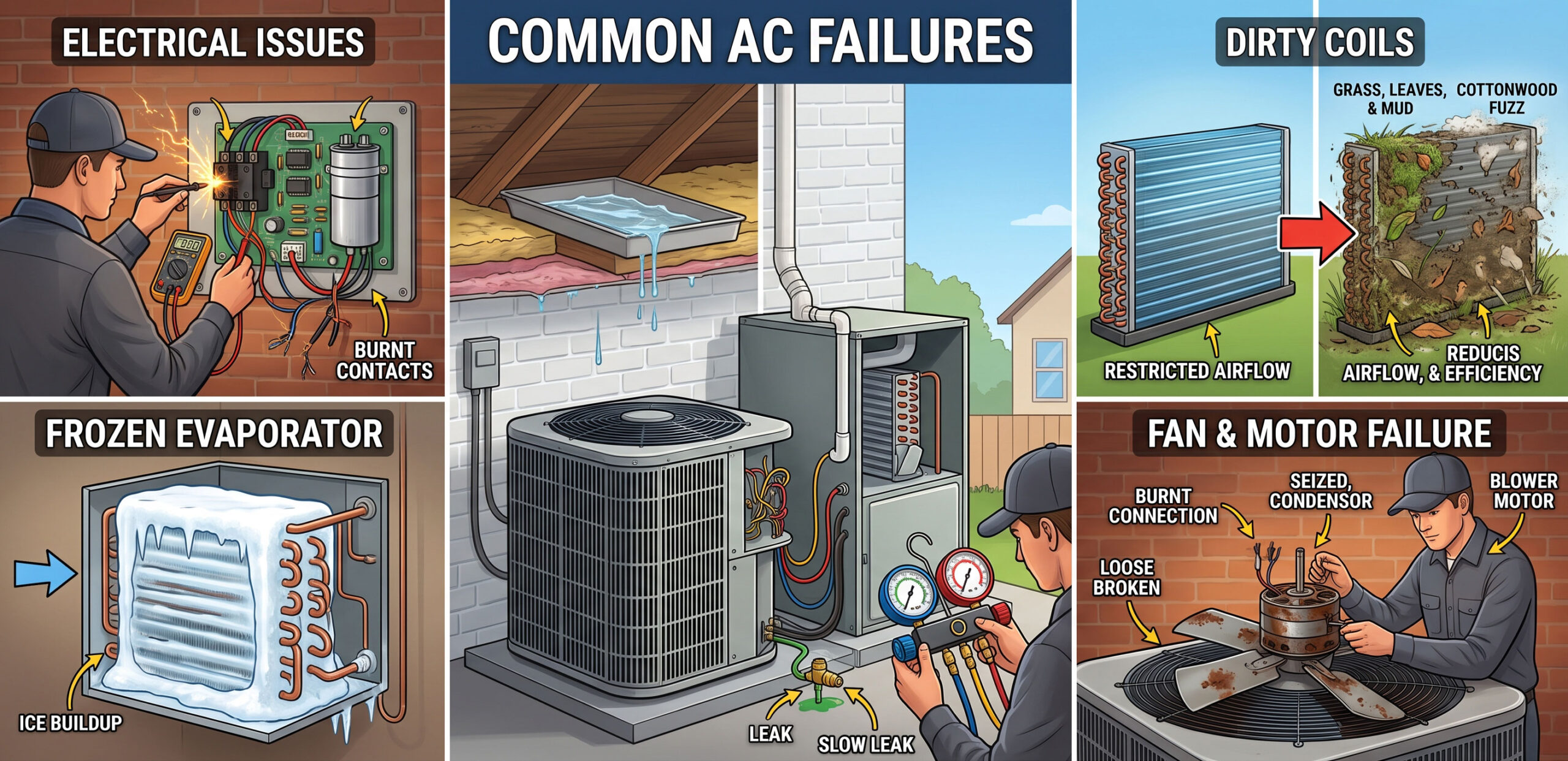
Quick Answer: The most frequent air conditioning failures in The Woodlands, Spring, and Conroe are blown run capacitors degraded by 130°F+ attic and cabinet heat, clogged condensate drain lines resulting from 15+ gallons of daily moisture extraction, and pitted contactor switches aggravated by long run cycles and native fire ant infestations. Diagnostic technicians at Majestic AC recommend semi-annual multi-point inspections to identify these heat-related failure points before they trigger complete compressor burnout.
In communities across The Woodlands, Spring, Shenandoah, and Montgomery County, residential HVAC systems operate in an exceptionally harsh operating environment. From the dense pine tree canopy surrounding Creekside Park, Alden Bridge, and Panther Creek to the humid microclimates along Spring Creek and Lake Woodlands, cooling systems face sustained 95°F+ afternoon temperatures paired with ambient humidity levels routinely topping 80%.
Under these conditions, an air conditioner is not merely cycling occasionally—it runs under continuous electrical and mechanical load for seven to eight months every year. At Majestic AC, our field diagnostic logs show that local environmental factors directly drive five distinct mechanical breakdown points.
1. Blown Run and Start Capacitors (Extreme Cabinet Heat)
Capacitors act like small, heavy-duty electrical storage reservoirs, providing the microfarad (µF) burst required to start and keep the outdoor compressor and condenser fan motors spinning.
The Woodlands Climate Threat: Prolonged ambient heat combined with thermal radiation. When heat indexes across Montgomery County exceed 105°F, metal exterior electrical access panels facing direct afternoon sun experience internal cabinet temperatures well over 130°F. This intense heat causes the capacitor’s internal dielectric fluid to boil, expand, and break down internally.
Observable Symptoms:
- A continuous, low hum or buzzing sound from the outdoor unit without the fan spinning.
- The condenser fan blades stay motionless until given a manual nudge with a stick.
- The indoor blower pushes lukewarm or room-temperature air through your supply vents.
- The top terminal plate of the cylindrical capacitor is visibly bulged or domed.
2. Burnt and Pitted Contactors (Electrical Arcing & Native Pest Infiltration)
The contactor is the high-voltage electromechanical switch that closes to deliver 240 volts of electricity to the outdoor components whenever your indoor thermostat signals a call for cooling.
The Woodlands Climate Threat: High cycling frequency and native insects. Extended 100°F afternoons in South Montgomery County force units to cycle dozens of times daily under heavy electrical load. Every connection produces miniature electrical arcs that gradually pit and carbonize the contact pads. Furthermore, native Texas pests—specifically imported fire ants (Solenopsis invicta) and Tawny crazy ants—are chemically attracted to the electromagnetic fields generated inside outdoor electrical disconnects. Ants crawl between open contact points, get crushed or electrocuted, and build a physical barrier that prevents the circuit from closing.
Observable Symptoms:
- The outdoor condenser unit runs continuously and refuses to shut down even when the thermostat is set to “Off” (welded or stuck contacts).
- Clicking or chatter noises from the condenser as the system struggles to engage.
- The indoor thermostat shows cooling is active, but the outdoor condenser fails to turn on.
3. Clogged Condensate Drain Lines & Float Switch Shutdowns
Because relative humidity across The Woodlands and Spring often hovers between 75% and 90%, an air conditioner acts as a whole-home dehumidifier, condensing an average of 10 to 20 gallons of water daily out of a typical 2,500-square-foot home.
The Woodlands Climate Threat: Biological growth inside warm, unconditioned attics. In typical two-story homes in neighborhoods like Sterling Ridge or Grogan’s Mill, air handlers and primary PVC drain lines sit in attic temperatures that routinely exceed 130°F. This creates a hot, damp environment where airborne dust, microscopic pine pollen, and ambient bacteria combine into a dense, gelatinous microbial slime (zooglea). The line clogs, backing up condensation into the drain pan.
Observable Symptoms:
- The cooling system abruptly shuts off, and your digital thermostat display goes completely blank (triggered by an activated safety float switch cutting the 24V circuit).
- Water actively drips from the secondary emergency drain pipe located outside over a prominent window, porch, or flowerbed.
- Water staining, drywall softening, or blistering paint appearing on upper-story ceilings directly below the attic air handler.
4. Fouled Condenser Coils (Loblolly Pine Needles, Pollen, and Lawn Debris)
The outdoor condenser coil expels heat pulled from inside your home into the outdoor atmosphere. This heat transfer requires thousands of micro-thin aluminum fins to maintain unrestricted airflow.
The Woodlands Climate Threat: Heavy tree canopy particulate. The Woodlands’ signature pine canopy drops massive quantities of Loblolly pine needles, yellow pine pollen in early spring, and fine organic debris directly into condenser cabinets. Sudden afternoon gulf storms splash wet mud, pine straw, and cut grass into the coil faces. As this mixture bakes under direct sunlight, it forms a hardened, insulating coat over the aluminum fins, choking heat dissipation.
Observable Symptoms:
- The fan exhaust discharging from the top of the outdoor unit feels lukewarm instead of hot.
- Longer, non-stop cooling cycles accompanied by higher Montgomery County electrical bills.
- The compressor trips on internal thermal overload during the hottest part of the afternoon (2 PM–6 PM).
5. Frozen Evaporator Coils and Formicary Corrosion
The indoor evaporator coil absorbs heat and latent moisture inside your home’s air stream. Despite outside heat waves, this indoor coil can freeze solid into a thick block of ice.
The Woodlands Climate Threat: Fine dust accumulation and chemical degradation. High humidity keeps evaporator fins moist. As fine household dust passes through standard air filters, it cakes onto the coil faces, restricting airflow. Simultaneously, tightly sealed modern homes trap off-gassed household volatile organic compounds (VOCs from cleaning products, building adhesives, and paints). These vapors dissolve into the condensate on the coil, forming formic and acetic acids that cause formicary corrosion—microscopic pinhole leaks through the copper tubing that slowly bleed out refrigerant.
Observable Symptoms:
- Frost or visible ice forming along the insulated copper suction line running into your outdoor unit.
- Reduced airflow coming from ceiling vents.
- The system runs continuously while indoor temperatures hover uncomfortably at 78°F or higher.
Summary of Failure Modes in The Woodlands & Spring
| Component | Local Environmental Threat | Primary Symptoms |
| Run Capacitor | Attic/cabinet heat (>130°F) boiling dielectric oil. | Humming unit; fan fails to spin; system blows warm air. |
| Contactor Switch | Electrical arcing + fire ants bridging contact points. | Chattering noise; outdoor unit won’t start or won’t shut off. |
| Condensate Line | Microbial slime blooms from draining 15+ gal/day in hot attics. | Blank thermostat; tripped float switch; ceiling water leaks. |
| Condenser Coil | Pine pollen, pine needles, and baked-on organic lawn silt. | High electric bills; compressor tripping on high thermal limit. |
| Evaporator Coil | Dust-choked airflow + formicary pinhole refrigerant leaks. | Solid ice block on indoor coil and outdoor copper line. |
Frequently Asked Questions (FAQ)
In most homes across The Woodlands and Spring, a blank thermostat indicates that your inline condensate safety float switch has tripped. When your primary PVC drain line clogs with algae or microbial slime, condensation backs up into the drain pan. To protect your ceiling drywall from thousands of dollars in water damage, the safety switch automatically cuts the low-voltage power supply to the thermostat and stops the system. Clearing the drain line and resetting the switch restores operation.
Yes. Imported fire ants and Tawny crazy ants are commonly attracted to the electromagnetic fields produced by 240-volt contactor switches. When an ant crawls across the contacts and gets shocked, it releases an alarm pheromone that attracts thousands more. They pack between the contact points, creating an insulating layer that prevents electrical current from flowing to the compressor and fan motor.
Ice accumulation is never normal. It occurs when restricted airflow (such as a dust-choked air filter or dirty coil) or low refrigerant levels (caused by pinhole leaks) cause the evaporator coil’s internal temperature to drop below 32°F. Ambient indoor moisture freezes instantly on contact, eventually encasing the coil in solid ice. If this occurs, switch your thermostat from “Cool” to “Off”, set the fan setting to “On” to begin melting the ice, and call a licensed technician.
Due to heavy spring pine pollen and ambient humidity, outdoor condenser coils should be chemically cleaned using a non-acidic wash at least once per year during your spring tune-up. Homes located under dense pine canopies in neighborhoods like Cochran’s Crossing, Alden Bridge, or Indian Springs often benefit from bi-annual coil inspections to ensure debris does not restrict airflow.
Majestic AC provides certified diagnostic evaluations, emergency repairs, and preventative maintenance throughout The Woodlands, Spring, Tomball, and Montgomery County. Operating under Texas License #TACLB00017662E, Majestic AC’s certified technicians carry precision multi-meters, thermal imaging gear, and fully stocked trucks to test capacitors, clear clogged condensate drain assemblies, and resolve high-heat electrical failures in a single visit.