

Quick Read Summary:
Maintaining a residential HVAC system in Spring, Texas, requires a proactive strategy built around the region’s intense subtropical climate. With summer temperatures regularly exceeding 90°F, attic temperatures soaring past 130°F, and relative humidity averaging 70% to 90%, home cooling systems operate for up to 18 hours daily during peak months. This continuous operation pulls 10 to 20 gallons of moisture from indoor air each day, making systems exceptionally vulnerable to drain line clogs, capacitor degradation, and coil fouling from heavy seasonal pine pollen.
To maximize energy efficiency, prevent mid-summer equipment failures, and extend system lifespan, homeowners should adhere to a structured maintenance framework:
- Bi-Annual Professional Inspections: Schedule an AC tune-up in early spring (February–April) to check refrigerant charge, electrical tolerances, and coil integrity, followed by a heating and furnace safety check in late fall (October–November).
- Monthly Condensate Line Care: Pour 1 cup of distilled white vinegar into the indoor drain line T-pipe monthly from May through October to prevent biological sludge, drain pan overflows, and severe structural water damage.
- Routine Filter & Airflow Management: Replace 1-inch MERV 8–11 pleated air filters every 30 to 60 days during peak cooling, and maintain a 24-inch clear clearance perimeter around the outdoor condenser unit.
- Early Warning Detection: Address continuous runtime without cooling, ice accumulation on refrigerant lines, or unusual electrical humming immediately to avoid premature compressor failure.
By combining consistent DIY preventative care with expert seasonal servicing from local specialists like Majestic AC, Spring homeowners can maintain optimal indoor comfort while keeping monthly utility costs under control.
Maintaining a residential heating, ventilation, and air conditioning (HVAC) system in Spring, Texas, requires a proactive strategy tailored to the region’s distinct subtropical climate. Located in northern Harris County, Spring experiences prolonged, hot, humid summers, frequent thunderstorms, seasonal pollen waves, and brief mild winters punctuated by sharp cold fronts.
Because air conditioners in South Texas operate almost continuously from early spring through late autumn, unmaintained systems suffer from rapid efficiency loss, high energy bills, and accelerated mechanical failure. This comprehensive guide outlines the technical, operational, and preventative maintenance protocols necessary to keep home comfort systems operating at peak performance year-round.
The Environmental Challenges of Spring, TX on HVAC Systems
Understanding why HVAC systems fail or lose efficiency in Spring requires analyzing the local environmental factors that place exceptional load on residential cooling equipment.
Extreme Heat and Extended Cooling Seasons
In Spring, ambient temperatures consistently exceed 90°F from late May through September, often pushing past 100°F during peak summer heatwaves. Combined with radiant heat absorption through residential roofs into attic spaces—where air handlers and ductwork are typically installed—attic temperatures can easily reach 130°F to 140°F.
When outdoor temperatures stay elevated for weeks, a home’s air conditioner operates between 12 to 18 hours per day. This prolonged cycle time places continuous mechanical stress on critical components, including:
- Run and Start Capacitors: Heat degrades internal dielectric fluid, leading to electrical failure.
- Compressor Units: High head pressures increase operating temperatures within the compressor, accelerating internal valve and bearing wear.
- Blower Motors: Continuous duty cycle in superheated attic environments increases thermal friction and degrades motor insulation.
High Relative Humidity and Moisture Control
Spring, Texas, sits within the Gulf Coast plain, where summer relative humidity levels routinely average between 70% and 90%. Air conditioning systems function not only as space coolers but also as primary dehumidifiers.
To lower indoor humidity, the system relies on the evaporator coil to pull water vapor out of the air. As warm, humid air passes over the cold coil, condensation forms and drains into a collection pan. On a typical summer day, a residential AC unit in Spring can extract between 10 to 20 gallons of water from indoor air. High moisture production creates specific operational risks:
- Algae and Bio-film Growth: Warm PVC drain lines provide an ideal environment for algae, bacteria, and fungal slime to accumulate, leading to system clogs.
- Condensate Overflows: Blocked drain lines cause water to back up into the primary or secondary drain pans, leading to ceiling collapses, drywall rot, and dangerous mold infestation.
- Corrosion: Constant exposure to high humidity accelerates rust and corrosion on metal cabinets, copper line sets, and internal electrical connections.
Seasonal Pollen, Dust, and Organic Debris
Spring, Texas, is surrounded by heavy pine forests, oak trees, and dense foliage. During pine pollen season (typically February through April), thick layers of yellow dust cover outdoor condenser units.
- Condenser Coil Blockage: Pollen acts as a thermal blanket on the aluminum fins of the outdoor coil. This restricts airflow and prevents the unit from releasing absorbed heat, forcing the system to consume more electricity.
- Lawn Care Debris: Summer grass clippings, soil dust, leaves, and weed seed quickly pull into the condenser cabinet via the suction fan, blocking airflow and insulating electrical compartments.
Critical System Components and How Maintenance Protects Them
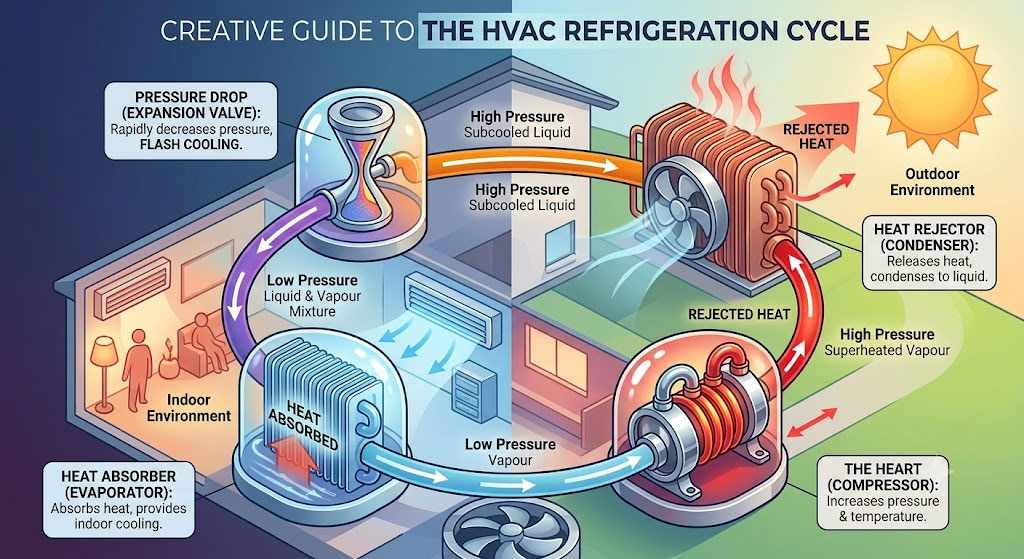
An HVAC system is a complex, closed-loop mechanical and electrical ecosystem. Failing to maintain one component creates a domino effect that impacts the entire system.
1. The Indoor Evaporator Coil
Located inside the indoor air handler or furnace casing, the evaporator coil contains cold, low-pressure liquid refrigerant. As indoor air passes over the aluminum fins, heat and humidity transfer into the refrigerant.
Maintenance Need: Dust or dirt bypassing poor air filters forms a layer of grime over the damp fins. This grime acts as an insulator, preventing heat absorption. As a result, the refrigerant cannot warm up properly, causing moisture on the coil to freeze solid into a block of ice.
2. The Outdoor Condenser Coil and Compressor
The compressor pumps hot, high-pressure vaporized refrigerant to the outdoor coil, where a large fan draws outside air through the fins to cool the refrigerant back into a liquid state.
Maintenance Need: If the condenser coil is coated in pollen or dirt, heat transfer drops sharply. System head pressure increases, forcing the compressor to draw higher electrical amperage. Running a compressor under high head pressure shortens its operational life by years and increases monthly electricity bills.
3. Electrical Capacitors and Relays
Capacitors store electrical energy to start and run the heavy motors inside the compressor, outdoor fan, and indoor blower.
Maintenance Need: In Texas heat, capacitors lose their storage capacity (measured in microfarads or µF) over time. Operating a system with a weak capacitor causes motors to start slowly, run hot, and eventually burn out their internal wiring coils.
4. The Condensate Removal Network
Composed of a primary drain pan, primary PVC drain line, secondary emergency pan, and safety float switches.
Maintenance Need: Biological sludge must be treated routinely. Safety float switches must be tested to ensure they automatically shut down the system if water rises, preventing structural water damage to the home.
Seasonal Maintenance Timelines for Spring, TX Homeowners
Preventative maintenance must be timed to prepare equipment for extreme operational demands. In South Texas, the annual maintenance calendar differs significantly from northern regions.
Spring Maintenance Window (February – April)
The primary objective of spring maintenance is preparing the cooling infrastructure before high ambient heat arrives.
- Inspect, test, and clean the outdoor condenser unit.
- Deep clean pollen and organic debris from coil fins.
- Verify proper refrigerant charge (subcooling and superheat measurements).
- Check electrical connections, test capacitor tolerances, and inspect contactor points.
- Flush, treat, and clear indoor condensate lines and test primary/secondary float switches.
Summer Operation Window (May – September)
During the months of peak runtime, focus shifts to monitoring and routine homeowner upkeep.
- Check air filters every 30 days; replace as needed.
- Perform monthly preventative vinegar flushes on the primary condensate line.
- Maintain clear clearance around the outdoor unit.
- Monitor indoor humidity levels; ideal indoor relative humidity should remain between 45% and 55%.
Fall Maintenance Window (October – November)
Even though winters in Spring, TX are generally mild, heating systems must be inspected before brief freezing temperatures occur.
- Inspect gas furnaces for crack-free heat exchangers to prevent carbon monoxide exposure.
- Test ignition systems, flame sensors, and gas pressure manifold settings.
- Inspect electric heat strips in heat pump systems to prevent circuit breaker trips.
- Check flue pipes and vent terminations for bird nests, wasp hives, or physical damage.
Winter Operation Window (December – January)
- Check filters monthly during intermittent heating runs.
- Verify reverse-cycle operation on heat pump systems, including defrost cycles.
Step-by-Step Homeowner Maintenance Protocols
While technical diagnostics require a licensed HVAC professional, homeowners can perform critical routine maintenance tasks that account for nearly 50% of preventable system failures.
Protocol 1: Air Filter Selection and Replacement Strategy
Air filtration directly affects system lifespan and indoor air quality. Choosing the right filter and replacing it at correct intervals prevents airflow starvation.
Step-by-Step Replacement Steps:
- Turn off power to the HVAC unit at the thermostat or breaker panel before opening filter access doors.
- Note filter dimensions (Length x Width x Thickness). Standard return grilles take 1-inch filters, while dedicated media cabinets take 4-inch or 5-inch media filters.
- Verify airflow direction arrows printed on the filter frame. The arrow must point toward the blower motor/air handler, not out toward the room.
- Inspect old filter: If grey, heavy with dust, or bowed inward, replacement was overdue.
- Set calendar reminders: 1-inch filters in Spring, TX should be changed every 30 days during summer, and every 60 days in off-seasons. Media filters (4-5 inches) should be replaced every 6 to 12 months.
Protocol 2: Condensate Drain Line Maintenance
Biological growth inside dark, wet PVC pipes is the single leading cause of emergency AC shutdowns and water damage in Spring, TX.
Step-by-Step Clearing Procedure:
- Locate the primary air handler (typically in the attic or a dedicated utility closet).
- Identify the PVC condensate line exiting the unit and locate the open vertical T-pipe access port (usually un-capped or covered with a removable cap).
- Slowly pour 1 cup of distilled white vinegar directly into the T-pipe access point once per month from May through October.
- Allow the vinegar to sit in the line for 30 minutes to kill algae, mold spores, and bacterial slime.
- (Optional) Flush the line with 2 cups of warm water to carry loose debris through the exit drain point outside the home.
Note: Avoid using concentrated bleach if your system drains into a yard or plant bed, or if the system connects to a condensate pump, as bleach fumes can degrade plastic components and internal rubber seals.
Protocol 3: Outdoor Unit Exterior Care
Maintaining proper clearance around the outdoor condenser ensures heat can dissipate efficiently into the surrounding air.
Step-by-Step Cleaning Procedure:
- Shut off electrical power at the outdoor disconnect box located on the wall next to the condenser unit.
- Remove physical blockages: Clear grass, fallen leaves, mulch, and weeds within a 24-inch perimeter around the cabinet.
- Trim branches: Prune tree limbs and shrubs above the unit to ensure at least 5 feet of overhead clearance.
- Rinse the coil: Attach a standard spray nozzle to a garden hose. Direct the water stream from the top down, spraying inward through the metal cabinet louvers at a 45-degree angle to wash away pollen and dirt.
Important: Never use high-pressure washers, which will bend thin aluminum coil fins and ruin the unit’s airflow.
Professional HVAC Tune-Ups vs. DIY Maintenance
While homeowner care handles basic cleanliness, professional HVAC technicians use specialized diagnostic equipment to measure performance parameters invisible to the naked eye.
| Maintenance Task | DIY Homeowner Task | Professional Certified Technician |
| Filter Replacement | Yes | Inspection & Media Cabinet Servicing |
| Clear Condenser Area | Yes | Deep Chemical Coil Cleaning |
| Drain Line Flush | Yes | High-Pressure Flush & Vacuum Evacuation |
| Visual Vent Check | Yes | Static Pressure & Duct Leakage Analysis |
| Refrigerant Level Check | No | Yes (Superheat/Subcooling via Manifold Gauges) |
| Capacitor Diagnostics | No | Yes (Microfarad Tolerance Testing via Multimeter) |
| Electrical Tightening | No | Yes (Amperage Draw & Voltage Drop Analysis) |
| Gas Furnace Inspection | No | Yes (Flue Gas Analysis & Heat Exchanger Check) |
| Blower Assembly Care | No | Yes (Motor Amp Testing & Wheel Balancing) |
Professional Diagnostic Protocols: What to Expect During a Service Visit
A thorough professional tune-up should take between 45 to 90 minutes per system. Understanding what a qualified technician does helps homeowners verify that true preventative service is being performed.
Electrical and Safety Testing
- Capacitor Rating Checks: Technicians use a digital multimeter set to capacitance to measure the start and run capacitors. If capacitance drops by more than 5% to 10% below its factory rating, it is replaced before it fails and causes a motor burn-out.
- Electrical Tightening: High voltage vibration causes electrical terminal screws to loosen. Technicians tighten all line-voltage and low-voltage connections to prevent arcing, melted wires, and contactor pitting.
- Contactor Points Inspection: The contactor acts as a high-voltage switch turning on the outdoor unit. Technicians inspect the copper points for pitting or burning caused by electrical arc surges.
Refrigerant Circuit Verification
A system low on refrigerant cannot cool effectively and will eventually freeze its indoor coil or damage the compressor.
- Subcooling Measurement: For expansion valve (TXV) systems, technicians calculate subcooling—the difference between the liquid line temperature and the saturation temperature. This reveals whether the liquid line has an accurate amount of refrigerant charge.
- Superheat Measurement: For fixed orifice systems, superheat measurement ensures liquid refrigerant is not returning to the compressor, which causes mechanical liquid slugging.
Airflow and Static Pressure Analysis
System cooling capacity relies heavily on correct CFM (cubic feet per minute) airflow over the evaporator coil.
- Technicians measure Total External Static Pressure (TESP) across the indoor unit using a manometer. High static pressure indicates restricted ductwork, undersized return grilles, or a dirty indoor coil.
Common HVAC Warning Signs in Spring, TX
Recognizing early warning signs allows homeowners to fix minor issues before they turn into complete mechanical failures during a 100°F summer afternoon.
1. The System Runs Continuously Without Lowering Temperature
- Possible Causes: Dirty outdoor coil, severe air filter clog, low refrigerant charge due to a line set leak, or an undersized/failing compressor.
- Action: Check filter first. If clean, shut off unit to prevent compressor overheating and call a technician.
2. Warm Air Blowing From Supply Vents
- Possible Causes: Tripped outdoor breaker, failed capacitor keeping the outdoor unit from starting, or frozen evaporator coil blocking airflow.
- Action: Verify breaker at main electrical panel. Check the indoor air handler for ice along copper line set pipes.
3. Ice Buildup on Copper Refrigerant Lines
- Possible Causes: Restricted airflow (dirty filter, closed vents) or low refrigerant levels.
- Action: Turn thermostat from “Cool” to “Off”, and turn the fan switch to “On” to melt the ice. Do not scrape ice off pipes mechanically.
4. Unusual Noises During Startup or Operation
- Squealing or Screeching: Failing blower motor bearings or loose fan belt.
- Loud Buzzing/Humming: Failed capacitor attempting to start a seized motor, or chatter in a loose relay contactor.
- Metal Clanking/Grinding: Loose fan blade or internal compressor rod failure.
5. Water Pooling Around the Indoor Unit or Leaking Ceiling
- Possible Causes: Blocked primary condensate drain, rusted primary drain pan, or non-functioning float switch.
- Action: Immediately shut off the HVAC system at the thermostat to stop condensation generation.
Energy Efficiency Strategies for Spring Homeowners
Optimize Thermostat Settings
Setting the thermostat to 78°F during summer months provides an ideal balance between comfort and energy efficiency. Programmable or smart thermostats can adjust temperatures up by 4°F to 6°F while the house is unoccupied during work hours, reducing total system runtime without causing the home to overheat.
Utilize Ceiling Fans Correctly
Ceiling fans cool people, not rooms, by creating a wind-chill effect on skin. During summer, set ceiling fan blades to rotate counter-clockwise at higher speeds to push air straight down. Remember to turn fans off when leaving a room to conserve energy.
Solar Heat Gain Reduction
South and west-facing windows allow large amounts of radiant heat into living spaces. Closing solar shades, solar screens, or thermal drapes during peak afternoon hours significantly decreases cooling loads on the air conditioner.
Frequently Asked Questions (FAQ)
In South Texas, your HVAC system should be professionally serviced twice per year:
Spring Tune-Up (February–April): Focuses on the air conditioning system, refrigerant levels, capacitors, and drainage network before extreme summer heat sets in.
Fall Inspection (October–November): Focuses on the furnace/heating system, heat exchanger integrity, electrical heat strips, and safety controls before winter cold snaps.
Continuous runtime without effective cooling usually points to restricted airflow or reduced heat transfer capability. The most common causes in Spring, TX include:
A heavy buildup of pine pollen or dirt on the outdoor condenser coil.
A severely clogged 1-inch indoor air filter.
Frozen evaporator coils caused by low airflow or a refrigerant leak.
A weak or failing start/run capacitor that prevents the outdoor compressor from operating.
For most residential HVAC systems in Spring, Texas, a MERV 8 to MERV 11 filter offers the optimal balance between high filtration efficiency and proper system airflow. MERV 8–11 filters capture pollen, mold spores, and pet dander without creating excessive static pressure. Filters rated MERV 13 or higher can restrict airflow on standard residential blower motors unless your system was specifically engineered for high-static media cabinets.
High relative humidity during Texas summers causes air conditioners to extract 10 to 20 gallons of water daily. Water leaks occur when:
The primary PVC condensate drain line becomes clogged with biological algae or mold sludge.
Water fills the primary pan and overflows into the secondary emergency pan.
The secondary drain line becomes blocked or the safety float switch fails to shut off power to the system.
If you see water leaking, turn off your air conditioner at the thermostat immediately to prevent ceiling drywall damage and call a technician.
Distilled white vinegar is strongly recommended over household bleach. Concentrated bleach fumes can corrode internal copper evaporator coils, degrade plastic condensate pans, and damage rubber seals on condensate removal pumps over time. Additionally, if your drain line discharges near flower beds or grass, bleach can kill surrounding vegetation.
No, never use a high-pressure washer on your outdoor HVAC unit. The intense pressure will instantly bend and crush the delicate aluminum fins, blocking airflow and causing permanent coil damage. Instead, turn off power to the unit at the disconnect box and gently rinse dirt and pollen away using a standard garden hose directed downward at a 45-degree angle.