
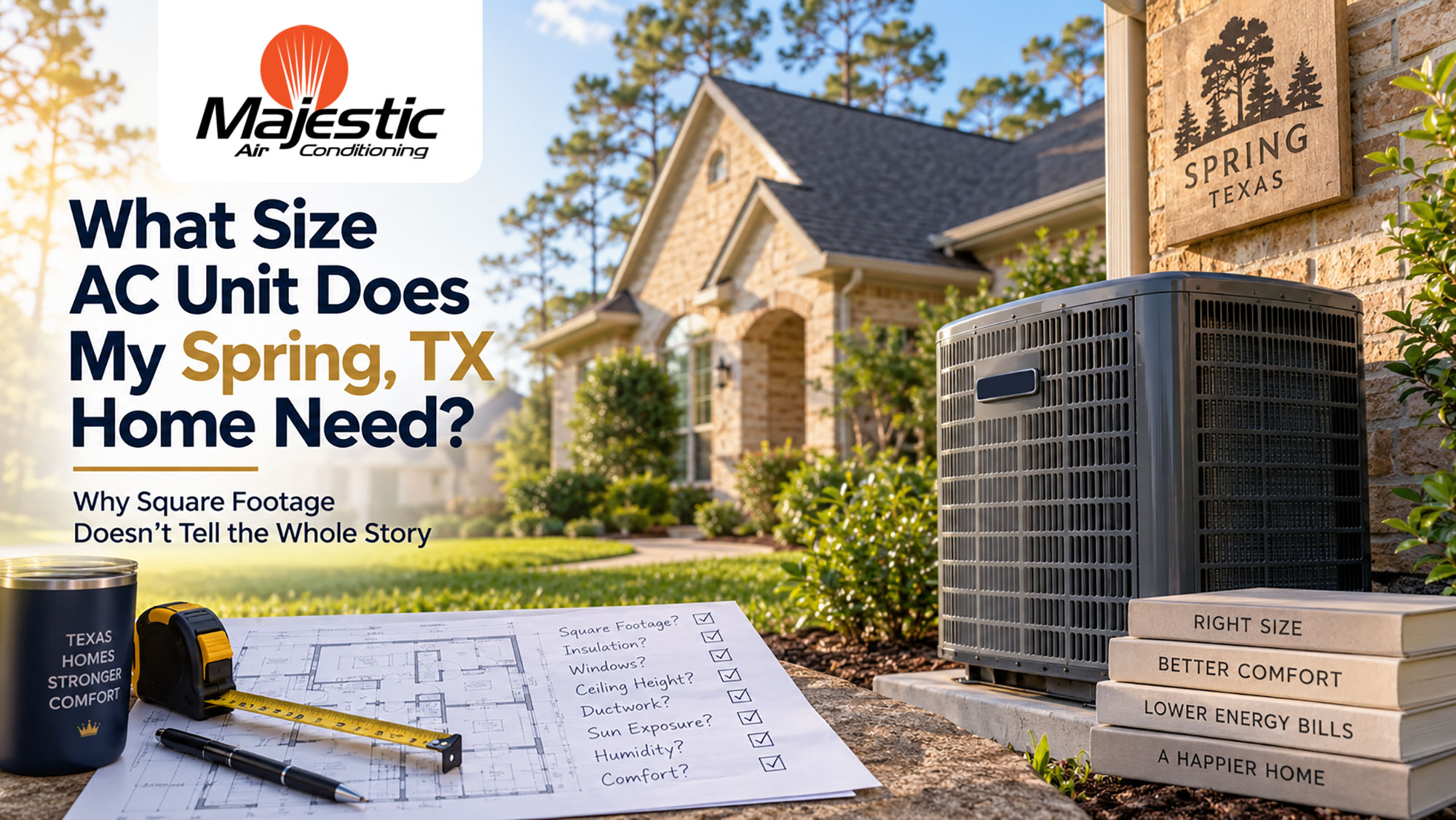
If you are replacing an air conditioner in Spring, Texas, one of the first questions you may ask is: What size AC unit does my home need?
It seems like there should be a simple answer based on square footage. A 1,500-square-foot house gets one size, a 2,000-square-foot house gets another, and so on.
Unfortunately, HVAC sizing does not work quite that neatly.
Two homes in Spring can have exactly the same square footage and still require different amounts of cooling. Insulation, windows, ceiling height, sun exposure, ductwork, air leakage, home design, indoor humidity and many other factors can significantly change how much cooling a house actually needs.
Choosing the wrong size can create comfort problems, higher energy bills and unnecessary wear on your HVAC equipment. In Houston-area humidity, an oversized air conditioner can create problems that homeowners may not expect.
At Majestic AC, we believe proper HVAC sizing should be based on the actual characteristics of your home rather than a quick square-footage estimate.
Quick Answer: How Do You Determine AC Size for a Spring, Texas Home?
The proper air conditioner size for a home in Spring, TX should be determined through a professional cooling-load calculation rather than square footage alone.
HVAC professionals commonly use a Manual J load calculation to estimate how much heat enters a home and how much cooling capacity the HVAC system needs to maintain comfortable indoor conditions.
The calculation considers factors such as:
- Home size and layout
- Insulation levels
- Window size and orientation
- Ceiling height
- Air leakage
- Roof and attic conditions
- Ductwork
- Number of occupants
- Sun exposure
- Local climate conditions
A larger home usually requires more cooling capacity, but square footage should be considered only one part of the equation.
What Does AC “Tonnage” Mean?
Residential air conditioners are commonly described in terms of tons.
That does not refer to how much the equipment weighs. In HVAC terminology, tonnage describes the system’s cooling capacity.
One ton of air-conditioning capacity equals approximately 12,000 BTUs of cooling per hour.
A typical residential system might therefore be rated as:
| AC Size | Approximate Cooling Capacity |
|---|---|
| 2 tons | 24,000 BTU/hr |
| 2.5 tons | 30,000 BTU/hr |
| 3 tons | 36,000 BTU/hr |
| 3.5 tons | 42,000 BTU/hr |
| 4 tons | 48,000 BTU/hr |
| 5 tons | 60,000 BTU/hr |
The important question is not simply, “How many tons can we fit?” It is: How much cooling capacity does this particular house actually require?
Can You Determine AC Size From Square Footage?
Square footage can provide a rough starting point, but it should not be used as the sole method for selecting a new HVAC system.
You may see charts online that provide estimates similar to the following:
| Home Size | Common Rule-of-Thumb Estimate |
|---|---|
| 1,200–1,500 sq. ft. | 2–3 tons |
| 1,500–2,000 sq. ft. | 2.5–3.5 tons |
| 2,000–2,500 sq. ft. | 3–4.5 tons |
| 2,500–3,000 sq. ft. | 4–5 tons |
| 3,000+ sq. ft. | 5 tons or multiple systems |
These numbers should not be treated as equipment recommendations.
They illustrate why homeowners frequently hear generalizations such as “about one ton per 500 square feet.” The problem is that two 2,000-square-foot homes can have dramatically different cooling requirements.
One may have upgraded windows, excellent attic insulation and shaded exposure.
The other may have large west-facing windows, older insulation, significant duct leakage and a second floor surrounded by a scorching attic.
Putting the same HVAC system in both houses would not necessarily produce the same results.
Why HVAC Sizing Matters So Much in Spring, Texas
Spring and the greater Houston area present some unusual challenges for residential air conditioning.
It is not just hot here.
It is hot and humid for long stretches of the year.
An HVAC system therefore has two important jobs:
- Lower the indoor temperature
- Remove moisture from the indoor air.
Those jobs are related, but they are not identical. A poorly sized air conditioner may technically cool your house while still leaving it feeling uncomfortable. That is one reason homeowners should resist the assumption that bigger equipment automatically means better comfort.
Bigger Is Not Always Better
It is easy to assume that installing a larger air conditioner will give you better performance.
After all, if a three-ton system is good, wouldn’t a four-ton system cool the house even better?
Not necessarily.
An oversized AC system can cool the home’s air very quickly. That sounds desirable until you consider humidity.
Air conditioners remove moisture while they operate. The longer air passes across the cold evaporator coil, the more opportunity the system has to remove moisture from indoor air.
If the system is significantly oversized, it may cool the house very quickly and shut off.
This is known as short cycling.
The thermostat may say 72°F or 74°F, but the house can still feel clammy because the system did not operate long enough to remove sufficient moisture.
That is particularly important in Spring and the Houston area.
Signs an AC System May Be Oversized
An oversized system can sometimes create symptoms homeowners do not immediately associate with equipment sizing.
You may notice the air conditioner turns on and off frequently rather than running steady cooling cycles.
Certain rooms may become cold quickly while others remain uncomfortable.
Indoor humidity may remain higher than expected.
You might also notice significant temperature swings, where the house becomes cold while the AC runs and then warms relatively quickly after it shuts off.
None of these symptoms automatically proves that a system is oversized. Airflow problems, thermostat issues, ductwork and equipment problems can create similar symptoms.
However, equipment sizing should be part of the investigation.
An Undersized AC Can Create Problems Too
Installing too little cooling capacity creates the opposite problem.
An undersized system may run for extremely long periods while struggling to reach the thermostat setting.
During especially hot afternoons, indoor temperatures may gradually rise even though the air conditioner appears to run continuously.
Energy consumption can increase because the system spends so much time operating near its maximum capacity.
Long runtimes by themselves are not always a problem. Modern HVAC systems are often designed to operate longer and more efficiently than older systems.
The concern is whether the system is actually maintaining indoor comfort.
If your AC runs continuously and the indoor temperature continues climbing significantly, something deserves further investigation.
Manual J: A Better Way to Size an Air Conditioner
Professional HVAC sizing typically begins with a Manual J residential load calculation. Rather than relying on a simple square-footage formula, the calculation estimates how much heat enters the home. The goal is to determine the home’s actual cooling load.
Think of your house as a container sitting outside in the Texas heat. Heat continually tries to enter through the roof, windows, walls, doors and air leaks. People, appliances and electronics also generate heat inside the home. The air conditioner must remove heat at roughly the same rate it enters if you want indoor temperatures to remain comfortable. A load calculation helps estimate exactly how much cooling capacity is required to accomplish that.
Insulation Can Dramatically Change Cooling Requirements
Attic insulation plays a major role in Houston-area HVAC performance.
During summer afternoons, attic temperatures can become considerably hotter than the outdoor temperature.
If the attic is poorly insulated, more of that heat can move into the living space below.
A house with strong attic insulation may therefore require less cooling than an otherwise identical home with deteriorated or insufficient insulation.
This is particularly important when replacing an older HVAC system.
If the home has received insulation upgrades since the previous AC was installed, simply replacing the old equipment with the same tonnage may not be the best approach.
Windows Matter More Than Many Homeowners Realize
Windows can contribute substantially to the cooling load. The size, number, efficiency and orientation of the windows all matter. Large windows facing west can receive intense afternoon sun. A room with several large west-facing windows may therefore require considerably more cooling than a room of the same size on the opposite side of the home.
Modern double-pane or Low-E windows may reduce heat transfer compared with older single-pane windows.
Window coverings and exterior shading can also affect solar heat gain.
That is why simply knowing the home’s square footage cannot tell the entire story.
Ceiling Height Changes the Equation
A 2,000-square-foot home with standard eight-foot ceilings contains substantially less conditioned air volume than a 2,000-square-foot home with vaulted ceilings and large open living areas.
The square footage is identical. The amount of space being conditioned is not. High ceilings are common in many Houston-area homes, and they should be considered during HVAC design.
One-Story and Two-Story Homes Can Behave Very Differently
Two-story homes create another set of challenges. Heat naturally rises, while upstairs rooms often sit directly beneath a hot attic. The second floor can therefore be noticeably warmer than the first floor.
Poor duct design can make the imbalance even worse. Some homes benefit from zoning systems or separate HVAC systems for different floors. Others can achieve excellent comfort with properly designed ductwork and a single system.
The correct approach depends on the home’s design, cooling load and existing HVAC infrastructure.
Ductwork Can Affect the Size of the System You Actually Need
Your HVAC system does not just produce cold air. It must deliver that air throughout the home. If the duct system cannot move the required amount of air, installing larger equipment may actually make performance worse.
Common duct problems include:
- Undersized ducts
- Leaking duct connections
- Crushed or damaged flexible ducts
- Poorly designed return-air systems
- Excessive duct length
- Inadequate supply registers
Ductwork located in an attic also operates in an extremely harsh environment during a Spring, Texas summer. Any conditioned air lost through duct leaks is essentially cooling your attic instead of your home.
Before significantly increasing equipment size, the duct system should be evaluated to determine whether it can support the required airflow.
Why Return Air Matters
Return-air design is one of the most overlooked parts of residential HVAC systems.
The system cannot properly distribute conditioned air unless it can also pull enough air back through the return side. An inadequate return can restrict airflow through the evaporator coil. That can reduce system performance and increase stress on the blower. Sometimes a homeowner believes the AC is too small when the real problem is insufficient airflow.
Correct diagnosis matters before equipment is replaced.
Home Age Makes a Difference
Spring contains homes built across many decades. Construction standards, insulation practices, windows, ductwork and air sealing can vary considerably depending on when the home was built. An older home that has never undergone efficiency improvements may require significantly more cooling than a recently constructed home of similar size.
However, age alone does not determine efficiency. A well-renovated older home may perform better than a newer house with duct leakage or installation problems. That is why an HVAC contractor should evaluate the actual house rather than make assumptions based purely on the year it was built.
What About Air Leakage?
Every house leaks some amount of air.
When hot, humid outdoor air enters the home through gaps around windows, doors, attic penetrations and other openings, the air conditioner must cool and dehumidify that additional air.
A relatively tight house can require less cooling than a drafty home of identical size. Air sealing can therefore improve both comfort and HVAC performance. It may even affect the size of replacement equipment that makes sense for the home.
Humidity Should Be Part of the Conversation
Temperature gets most of the attention during an AC replacement, but humidity has an enormous impact on comfort.
A home at 74°F with controlled humidity can feel very comfortable. A home at the same temperature with high indoor humidity may feel sticky and unpleasant. This is why Majestic AC looks at the overall comfort system rather than treating thermostat temperature as the only measurement that matters.
In some homes, proper equipment sizing and runtime can provide excellent humidity control. Other homes may benefit from additional solutions such as variable-capacity equipment or whole-home dehumidification.
Single-Stage, Two-Stage and Variable-Capacity Systems
Equipment technology can also influence comfort.
- Traditional single-stage air conditioners generally operate at full capacity whenever they run.
- Two-stage systems can operate at a lower capacity during milder conditions and switch to higher output when necessary.
- Variable-capacity equipment can adjust its output across a much wider operating range.
That flexibility can provide longer runtimes, steadier temperatures and improved humidity management. This does not eliminate the importance of proper sizing. Even sophisticated equipment should still be selected based on the home’s cooling requirements.
Should You Install the Same Size AC You Already Have?
Sometimes.
But homeowners should not automatically assume that the existing system was sized correctly. The original equipment could have been oversized or undersized from the beginning.
The home may also have changed. Perhaps you added insulation. Maybe you replaced the windows. A room addition could have increased the conditioned square footage. You may have enclosed a patio or converted attic space. Even changes in ductwork can alter system performance.
A replacement is an excellent opportunity to reassess the home’s cooling requirements rather than blindly duplicate the previous system.
Why Did My Old AC Seem to Work Fine?
Homeowners sometimes wonder why a new contractor recommends a different size when the old AC seemed to cool the house successfully.
Several explanations are possible.
- Older systems may have operated differently than modern equipment.
- The original system may have been oversized but still kept the house cold.
- Changes to insulation, windows or ductwork may have altered the home’s cooling load.
- The existing system may also have gradually lost performance, making it difficult to remember how it behaved when it was new.
The goal should not simply be to reproduce the old system. The goal should be to design the best system for the house as it exists today.
Can an AC Be Too Small for Texas Heat?
Yes, but homeowners should be cautious about assuming that system size is the reason an AC cannot keep up.
Several common HVAC problems can make a properly sized air conditioner perform as though it is too small.
These include dirty coils, restricted filters, refrigerant problems, failing blower components, leaking ducts and inadequate airflow.
A house that suddenly stopped cooling properly usually needs diagnosis before anyone concludes that the AC needs to be larger.
Equipment size does not normally become inadequate overnight.
How Much Should My AC Run During a Spring, Texas Summer?
During very hot weather, properly sized air conditioners may run for long periods. That is not necessarily a sign of trouble. Longer cooling cycles can actually be beneficial because they provide steadier temperatures and better moisture removal.
What matters is whether the system can maintain reasonable indoor conditions. An air conditioner that runs frequently while keeping your house comfortable may simply be doing its job. An AC that runs continuously while indoor temperatures steadily rise may have a mechanical, airflow, insulation, ductwork or sizing problem.
Why We Don't Recommend Choosing an AC From an Online Calculator Alone
Online HVAC calculators can be useful for getting a rough sense of equipment size.
They should not replace an in-home evaluation. Many calculators rely primarily on square footage and climate zones. They cannot always account for the real-world conditions that make homes different from one another.
A professional HVAC evaluation allows the contractor to inspect factors that a calculator cannot see. That includes duct condition, return-air design, attic installation, equipment location and unusual structural characteristics.
What Majestic AC Looks at Before Recommending a New System
When evaluating a Spring-area home for HVAC replacement, the goal should be to understand how the entire house behaves.
That means looking beyond the equipment sitting outside. The home’s existing comfort problems can provide important clues.
- Are certain rooms always warmer?
- Does the upstairs stay uncomfortable?
- Does the AC run constantly?
- Does the home feel humid even when the thermostat says it is cool?
- Are utility bills unusually high?
Understanding these patterns helps identify whether the problem involves equipment capacity, airflow, ductwork, humidity control or a combination of factors.
The Best AC Size Is the Size Your Home Actually Needs
When it comes to residential air conditioning, bigger is not automatically better and smaller is not automatically more efficient.
The right system should have enough capacity to keep your home comfortable during demanding weather while still providing reasonable runtimes and humidity control.
That balance becomes especially important in Spring, Texas.
Our combination of high temperatures, high humidity and long cooling seasons places unique demands on residential HVAC systems.
Square footage is useful information.
It simply is not enough information by itself.
Need Help Choosing the Right AC for Your Spring, TX Home?
If you are considering replacing your air conditioner, Majestic AC can evaluate your current system, home comfort, ductwork and cooling requirements before recommending new equipment.
Rather than relying on a one-size-fits-all tonnage estimate, our goal is to help homeowners choose an HVAC system that makes sense for the house they actually live in.
Whether you are dealing with uneven temperatures, high indoor humidity, rising energy bills or an aging system that may be approaching replacement, Majestic AC can help you understand your options.
Contact Majestic AC in Spring, Texas to schedule a complimentary HVAC evaluation and discuss the right cooling solution for your home.