When autumn arrives in Southeast Texas, it rarely follows a gentle, predictable curve. A balmy 88°F afternoon in Spring or The Woodlands can drop 40 degrees overnight when the season’s first cold front pushes through Harris and Montgomery counties. After six to seven months of relentless, high-humidity summer cooling, your HVAC system is suddenly forced to reverse its primary role.
Switching directly from cooling to heating without preparation places intense strain on aging equipment, triggers alarming odors, spikes utility bills, and—in worst-case scenarios—exposes your household to serious carbon monoxide or fire hazards.
Taking the time to properly transition your system and scheduling a comprehensive fall heating inspection ensures reliable warmth, peak energy efficiency, and peace of mind before the first freeze arrives.
Quick Summary for Homeowners:
To transition safely from AC to heating in North Houston, switch your thermostat to “OFF” for 15 minutes before selecting “HEAT,” replace summer-exhausted air filters, reverse ceiling fans clockwise on low, and clear at least two feet of fallen pine needles and debris from outdoor units. Schedule a professional fall furnace tune-up to inspect the heat exchanger for hairline cracks, clean oxidized flame sensors, test carbon monoxide levels, and verify safety limit switches before running the heat for the season.
The Southeast Texas Climate Reality: Why Heating Prep Matters Here
A common misconception among Gulf Coast homeowners is that heating maintenance is unnecessary because our cold season is short compared to northern states. In reality, intermittent operation is harder on mechanical heating equipment than continuous, predictable use.
Mechanical parts that sit idle in warm, humid attics for eight months are prone to oxidation, dust buildup, stuck valves, and biological growth in drain lines. When an arctic blast or hard freeze sweeps through Southeast Texas, thousands of households call for emergency service simultaneously, leading to overwhelmed dispatch boards and shivering nights.
Preparing early eliminates emergency breakdown risks and ensures your heating equipment operates efficiently under peak load.
Step 1: The Step-by-Step Thermostat and System Switchover
Switching your HVAC system from cooling to heating requires more than sliding a toggle across the wall plate. Rushing the changeover can cause electrical shorts or mechanical lockouts.
1. Give Your Compressor a Resting Period
Never switch directly from COOL to HEAT while your outdoor condenser is active. The sudden reversal can damage your compressor or trip low-voltage control fuses on the air handler control board.
- Turn the thermostat to OFF.
- Wait at least 10 to 15 minutes to allow refrigerant system pressures to equalize and control relays to reset.
- Switch the thermostat to HEAT and adjust the setpoint 2 to 3 degrees above current room temperature to initiate a call for heat.
2. Set Sensible Fall/Winter Setpoints
The U.S. Department of Energy and local utility providers recommend setting your winter thermostat to 68°F when home and awake, and dialing back 5 to 8 degrees while asleep or away. In high-humidity coastal Texas climates, setting the heat too high (74°F+) dries out mucous membranes, degrades indoor air quality, and causes substantial spikes in your natural gas or electric bills.
3. Reverse Your Ceiling Fans (Clockwise Rotation)
Ceiling fans cool people, not rooms, through convective wind chill. In the summer, blades rotate counterclockwise to push air downward.
- Locate the directional switch on the fan housing.
- Flip the direction to clockwise and select the lowest speed setting.
- This draws cool air upward toward the ceiling, displacing trapped warm air and pushing it gently down along the walls without creating a draft.
Step 2: The Critical Air Filter & Airflow Audit
Your HVAC air filter worked overtime from April through October filtering out heavy oak pollen, cedar fever allergens, pet dander, and coastal humidity moisture. Entering heating season with a restricted filter is the leading cause of early furnace breakdowns.
Why Dirty Filters Paralyze Heating Systems
Furnaces and electric heat strips require a steady, calculated volume of cubic feet per minute (CFM) across the heat exchanger. When a choked filter restricts return airflow:
- Heat Exchanger Overheating: Temperatures inside the furnace cabinet skyrocket past safe manufacturer thresholds.
- Limit Switch Tripping: The furnace’s high-limit safety switch will trip, cutting off the gas burner or heating elements while keeping the blower fan running continuously to cool the cabinet down.
- Heat Exchanger Cracking: Repeated cycles of extreme overheating and sudden cooling expand and contract the metal heat exchanger, producing stress fractures that leak carbon monoxide into your home’s ductwork.
| Filter Type | Typical Lifespan | Best Application for North Houston Homes | MERV Rating |
| 1-Inch Standard Pleated | 30–60 Days | Budget-friendly basic protection; inspect every 30 days during peak seasonal transitions. | MERV 6–8 |
| 4-Inch to 5-Inch Media Filter | 6–9 Months | Excellent for whole-home IAQ, low static pressure drop, superior dust capture. | MERV 10–13 |
| Electrostatic / Washable | Clean Monthly | Must dry completely before re-insertion; prone to restricting airflow if neglected. | MERV 4–6 |
Step 3: Understanding the "First Burn" Smell vs. True Hazard Signs
The first evening you turn on your heater, you will likely notice a distinct odor drifting through your supply registers. Understanding what is normal and what indicates an emergency will keep your household safe.
The Normal “First Burn” Odor
For months, microscopic household dust, lint, and pet dander have settled on the unheated metal surfaces of your furnace heat exchanger or electric auxiliary heating strips. During the first heating cycle, these biological particles incinerate.
- Character: A light, dry, dusty burnt odor.
- Duration: Should dissipate completely within 20 to 45 minutes of continuous operation.
- Action: Open windows slightly to ventilate the home and run the HVAC blower fan.
Warning Signs: When to Shut Off Your System Immediately
If you detect any of the following, turn off your thermostat and shut down your furnace at the power disconnect switch immediately:
- Rotten Egg or Sulfur Odor: Natural gas providers add mercaptan to gas supplies to signal leaks. If you smell sulfur, do not touch electrical switches or light candles. Evacuate immediately and call your gas utility provider or 911 from outside.
- Electrical Burning or Melting Plastic: Signals melted wire insulation, an overheated blower motor capacitor, or an overloaded electrical sequencer on heat strips.
- Rapid Clicking Without Ignition: Indicates a faulty pilot assembly, defective spark igniter, or a gas valve failing to open properly.
- Soot or Scorching Around the Burner Cover: Visible black residue indicates incomplete combustion, generating high levels of dangerous carbon monoxide.
Step 4: Outdoor Condenser & Heat Pump Fall Prep
While your indoor furnace or air handler produces heat, your outdoor unit still requires attention—especially in wooded areas like Spring, Cypress, and The Woodlands, where heavy pine needles, sweetgum balls, and live oak leaves blanket yards every autumn.
- Maintain a 24-Inch Clearance Zone: Clear away fallen branches, high grass, and creeping vines around your outdoor cabinet. Restricted exterior airflow degrades efficiency and attracts outdoor pests seeking warm winter shelter.
- Wash the Exterior Coil Fins: Use a standard garden hose with a gentle spray nozzle (never a high-pressure power washer) to rinse dirt, lawn clippings, and dust from the condenser fins.
- Avoid Full Enclosure Covers: Covering your outdoor condenser entirely with a canvas tarp or vinyl cover traps condensation and ground moisture inside the cabinet. This accelerates rust on copper joints and creates a sheltered nesting environment for mice and squirrels that chew through electrical wiring. If you wish to protect the top from falling debris, install a flat top-guard that leaves the sides open for ventilation.
- Special Considerations for Heat Pump Systems: If your home uses a heat pump for both cooling and heating, your outdoor unit runs all year long. Ensure the unit sits level on an elevated pad, keeping base pan drainage holes clear so melted defrost water can drain freely without refreezing into a solid sheet of ice along the base pan.
Why a Professional Fall Heating Tune-Up is Essential in North Houston
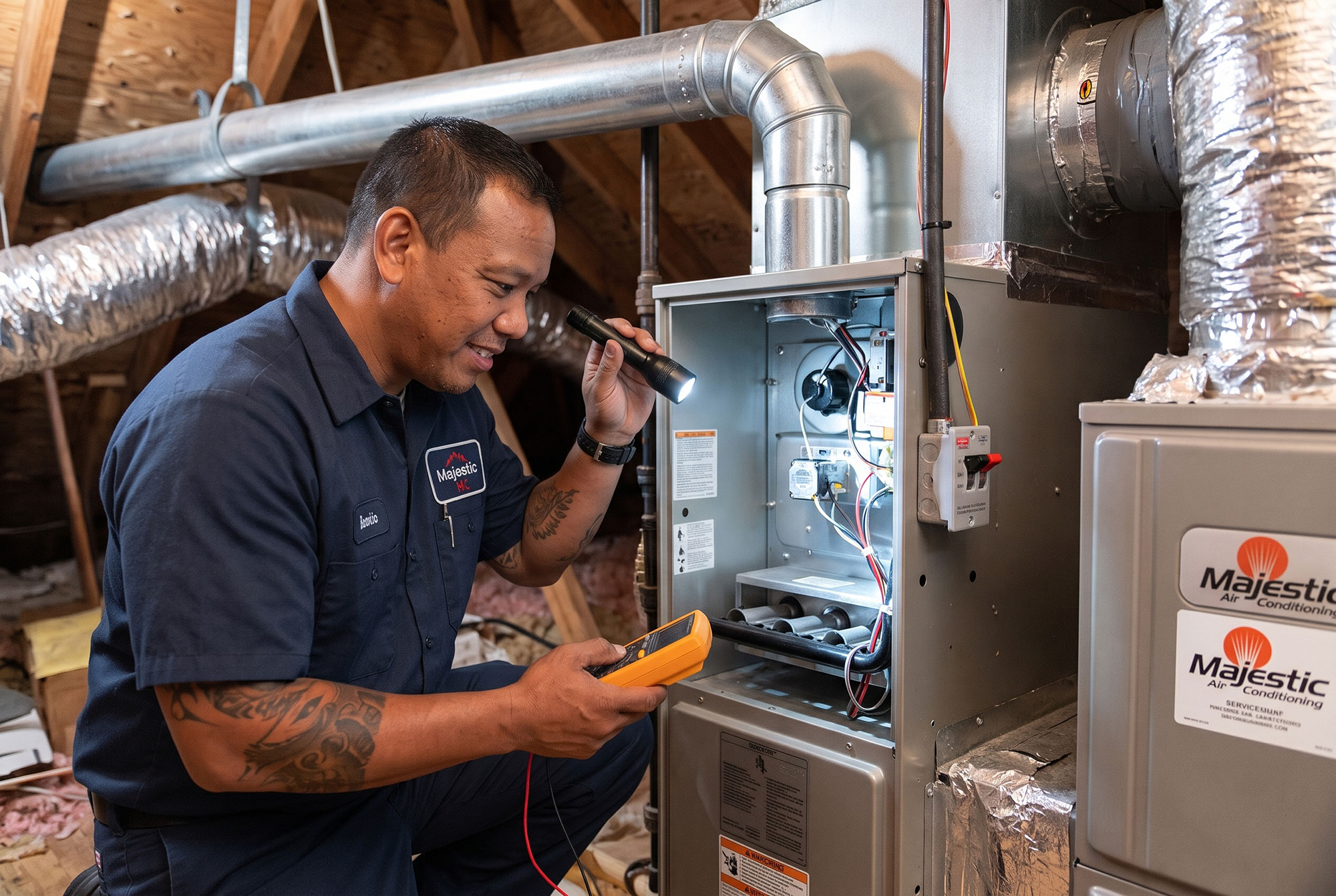
A comprehensive professional heating inspection does what visual homeowner checks cannot: it inspects internal electrical safety limits, verifies combustion efficiency, and checks the structural integrity of your heat exchanger.
1. Carbon Monoxide Detection & Heat Exchanger Safety
Natural gas furnaces burn fuel inside a sealed steel chamber called a heat exchanger. When fuel burns cleanly, harmful combustion byproducts (including carbon monoxide, an odorless, colorless, lethal gas) are exhausted safely through the flue pipe above your roof.
Over years of heating cycles, metal expands and contracts. In Southeast Texas, where units sit in humid, unconditioned attics reaching 130°F+ all summer, internal corrosion accelerates. A hairline crack can expand under heat, allowing carbon monoxide to enter the airstream delivering air to your bedrooms. A professional tune-up utilizes combustion analyzers and infrared inspection cameras to confirm heat exchanger integrity.
2. Cleaning the Flame Sensor
The flame sensor is a thin metal rod that sits directly in the furnace burner’s path. Its job is safety-critical: confirming that an open flame ignited when the gas valve opened. If no flame is detected within several seconds, it shuts down the gas valve to prevent fuel gas from pooling in your attic. Over time, microscopic oxidation and carbon buildup coat the rod, causing the furnace to cycle on for 3 to 5 seconds and immediately shut down. Annual maintenance polishes this sensor, preventing sudden no-heat lockouts.
3. Clearing Condensate Drain Lines
Modern high-efficiency furnaces (90%+ AFUE rating) produce acidic water vapor during combustion that drains away through PVC lines. If these condensate lines or trap assemblies become clogged with algae, slime, or dust during summer months, the furnace’s overflow float switch trips, preventing the system from firing at all.
4. Electrical Verification & Capacitors
A technician checks the operating amperage of your blower motor, inspects run capacitors for capacitance loss (drift exceeding ±5%), and verifies that electrical contactors are free of electrical pitting or carbon deposits. Catching a declining capacitor during fall maintenance prevents premature blower motor burnout.
What a Professional Fall Tune-Up Checklist Covers
| System Component | Inspection & Calibration Step | Homeowner Benefit |
| Heat Exchanger | Visual camera inspection & combustion draft testing for hairline cracks or corrosion. | Eliminates carbon monoxide contamination hazards. |
| Burner Assembly & Orifices | Vacuuming lint, adjusting air shutters, and inspecting flame color. | Ensures complete fuel combustion and lowers gas usage. |
| Flame Sensor & Igniter | Cleaning oxidation; measuring microamp signals and igniter resistance. | Prevents sudden short-cycling and no-heat lockouts. |
| Blower Motor & Wheel | Measuring amp draw, testing run capacitor, cleaning dust buildup. | Protects motor from burnout and maximizes airflow delivery. |
| Safety High-Limit Switches | Testing roll-out and high-limit switches under simulated temperature rise. | Prevents cabinet overheating and protects against fire risks. |
| Flue Pipe & Vent System | Inspecting joint seals, clearances, and draft pressure out the roof. | Guarantees toxic exhaust gases exit the home safely. |
| Gas Pressure / Manifold | Checking static and operating manifold gas pressure with a digital manometer. | Prevents noisy delayed ignition and thermal stress. |
| Thermostat Calibration | Verifying cycle rate algorithms, heat anticipator, and temperature accuracy. | Eliminates wide temperature swings and uneven heating. |
Gas Furnaces vs. Heat Pumps: Understanding Your Setup
Homes across Spring, Klein, Tomball, and Cypress generally fall into two categories: natural gas furnace systems and electric heat pump systems. Knowing your equipment type is crucial for winter operation.
Traditional Gas Furnaces
Standard in most single-family subdivisions throughout Champion Forest, Memorial Northwest, and Spring. These systems ignite natural gas to heat metal tubes, utilizing an electric blower to push air across the hot metal.
- Strengths: Produces warmer register discharge air (typically 110°F–120°F), warming homes rapidly during severe freezing temperatures.
- Key Maintenance Focus: Combustion safety, gas valve pressure, flue draft, and carbon monoxide prevention.
Heat Pumps and Dual-Fuel Configurations
Common in newer master-planned developments in The Woodlands (Creekside Park) and Conroe. Instead of generating heat with combustion, heat pumps extract ambient heat energy from outside air and pump it inside.
- The “Cool Feeling” Air: Heat pumps blow air at roughly 90°F to 95°F. While warmer than your 68°F room, it feels cool to human skin (which sits around 98.6°F). This is normal operation, not a malfunction.
- The “Emergency Heat” / “Aux Heat” Trap: When outdoor temperatures drop below freezing, heat pumps activate auxiliary electric resistance heat strips to bridge the gap. If you manually switch your thermostat to Emergency Heat (EM HEAT) when unnecessary, you bypass the efficient compressor and rely entirely on high-draw resistance elements—often tripling electric utility costs for the cycle.
The Homeowner’s Fall-to-Winter HVAC Checklist
Keep your system running smoothly throughout the chillier months by following this simple timeline:
Early Fall (October – Early November)
[ ] Replace all standard 1-inch return air filters or inspect 4-to-5-inch media filters.
[ ] Test carbon monoxide detectors and smoke alarms; install fresh backup batteries.
[ ] Switch ceiling fans to spin clockwise on the lowest speed.
[ ] Clear a 24-inch perimeter around your outdoor condenser, removing fallen brush and pine straw.
[ ] Ensure all indoor supply registers and return air grilles are fully opened and unblocked by rugs or furniture.
[ ] Schedule a comprehensive professional fall heating tune-up with a licensed contractor.
Mid-Season (December – January)
[ ] Re-check your air filter every 30 to 45 days.
[ ] Check outdoor unit base pans after cold rain or sleet to ensure drainage passages remain open.
[ ] Maintain clear, unobstructed airflow around your attic furnace cabinet. Never stack holiday storage boxes against the furnace flue or access panels.
Local Service and Fall Safety with Majestic AC
A well-maintained heating system does more than keep your family comfortable—it protects your home against fire, dangerous carbon monoxide exposure, and costly mid-winter emergency repairs.
For over three generations, Majestic AC has served families across Spring, The Woodlands, Tomball, Cypress, and Greater North Houston. Our technicians are NATE-certified, background-checked, and dispatched in fully-stocked service vehicles to diagnose, clean, and verify your heating system’s safety in a single visit.
Ensure your heating system is ready for whatever this winter brings. Contact Majestic AC today to schedule your Home Heater Health Check or join our Crown Club for priority dispatch, repair discounts, and bi-annual maintenance throughout the year.
- Office Address: 17011 Seven Pines Dr., Spring, TX 77379
- Phone: (281) 376-2224
- Website: majestic-ac.com
- Licensing: Licensed & Insured (TACLB17662E)